Showing posts with label leeds psychogeography group. Show all posts

Wednesday, 1 February 2017

Terminalia Festival of Psychogeography Thurs 23 Feb 2017


Thursday 23 Feb is Terminalia, the feast day of Terminus, Roman god of boundaries and landmarks. If ever there was a feast day for Psychogeography, this would be it! Tim Waters, and members from the Leeds Psychogeography Group, have been doing a walk around the centre of Leeds visiting the medieval boundary stones since 2011 and this year there are a few extra events during the day. Please click here for full details.

Thursday, 19 June 2014

Open Source Mapping: GPS Trails on Campus

The following map shows the GPS trails of people who have walked around the University of Leeds campus area and have then loaded their data onto OpenStreetMap. OpenStreetMap is open source software by the OpenStreetMap Foundation and is a collaboration by its contributors providing free geographical data and mapping. Anyone can contribute by signing-up online. The data shown in the map below shows the walks made by people walking around campus while at the same time logging their route using GPS software on their smartphone. They have subsequently loaded this information onto OpenStreetMap. Some of the data on this map goes back to the campus dérives I did with Leeds Psychogeography Group in 2009 and our walks actually appear within the consolidation of trails you can see on this map.


© OpenSteetMap Contributors and CC Tim Waters

These lines are made up of tiny dots which are overlaid in places. The dots make up a trail by an individual, which can be seen when zooming into the map online. Each dot represents the moment when the GPS picked up a signal of that individual’s location. The darker the line, the more people have carried out this process while walking that particular route. Speed is indicated by a greater gap between dots. Pauses appear as a density of dots. The GPS device might indicate a route taken on a cycle or, also, in a car.

What is interesting about the above map is that no map outline is included in the image, nevertheless the outline of the campus appears in the accumulation of dots, as you can see by looking at this map which is taken from the Chamberlin, Powel and Bon Development Plan.


© University of Leeds and Chamberlin, Powell and Bon

This map (and the previous one on Blue Plaques) show the infinite possibility for cartographies to become ways of presenting personal and qualitative information while also handing over a degree of control of the mapping process and end result to the user/cartographer. The open source software that is often used for these types of collaborations also, to a large extent, disengages it from capitalist production and, hence, provides much more freedom of expression, production and distribution.

Related Links:
Open Source Mapping: Blue Plaques on Campus

Saturday, 3 March 2012

St George's Field: Decontextualization and Desire


Following on from my post Traversing Transversality, I would like to provide an example of schizocartography as it appears in the space of St George's Field, the University of Leeds cemetery.

Sculpture by Charlotte Deponeo
© Deborah Gardner


For her BA project in the School of Design, Charlotte Deponeo took casts of the text on the gravestones in St George's Field and rather than making further sculptures from these casts, the casts themselves were presented as the actual sculptures. One sculpture was placed outside the cemetery, but still on the university campus, near the School of Design, where it could then be stumbled upon by accident: indeed a number of us from Leeds Psychogeography Group found it on an organised walk one day.

This process of spatially decontextualizing the gravestones in the form of the cast (which looks like a kind of tomb), being placed elsewhere becomes part of a process of deterritorialization in the opening up of the (en)closed space of the cemetery to the outside. Félix Guattari explains that subjectivity is attached to territories, spatial and otherwise, which are ascertained in many ways, for example, through social and cultural determinations. (2008: 471:2) However "Territory can be deterritorialized, that is, it can open up, engage in lines of flight, and even move off course." (2008: 472) The words on the gravestone have also been decontextualized and reappropriated. Instead of only existing on their separate gravestones in situ in the cemetery, individual parts of the text of particular gravestones have been taken and placed together on the inside of the sculpture. This means they have been formed into a new semiotic assemblage: "Schizoanalysis [...] is interested in a diversification of the means of semiotization [...] it abandons the terrain of signifying interpretation for that of the exploring of assemblages of enunciation." (italics Guattari's) (2008: 395)

Charlotte has created an assemblage of enunciation in the form of her sculpture, by re-presenting the cemetery back to the university (and, in a sense, back to itself) by placing it in a different context, both spatially and materially: "The work of art, for those who use use it, is an activity of unframing, of rupturing sense [...] which leads to a recreation and a reinvention of the subject itself." (1995: 131) Guattari explains that this process of “recomposition” enables “a search for enunciative nuclei which would institute new cleavages between other insides and other outsides and which would offer a different metabolism of past-future where eternity will coexist with the present moment.” (1995: 90)

The schizoanalytic process involved in the making of the sculpture also has the function of bringing the past into the present and, in a sense, de-mythologizing it. Guattari explains what is happening in these situations: “Existential Territories become diversified, heterogenised. The event is no longer enclosed in myth: it becomes a nucleus of processual relay." (1995: 105-106) The dominant order of the institution becomes momentarily translucent, its image fades away and other histories are momentarily made available. The concept of myth was also significant to the Situationist International. In their critique of consumer culture they saw the city as being a mythologised space representing the hollow sign that appeared in the form of the spectacle. This meant that the city could then become a place where private desires were then played out in the public domain in a consumerist form. (McDonough 1994: 76) Guattari's schizoanalytic cartography helps reveal the myth of controlling aesthetics and enables a space for subjective desires to come into play. Guy Debord sees the powers employed by capitalism in urban design as applying processes to space in such a way as it become homogenised. (2005: 165 and 171) The landscaping of the cemetery could be considered to have resulted in a homogenised space, losing (hiding) its 'real' character and separating it from its origins.

Links:
St George's Field Fallow Again: A Schizocartography
The Psychogeography of Other Spaces
St George's Field: Traversing Transversality

References:
Debord, Guy. 2005. The Society of the Spectacle (Detroit: Black and Red).
Guattari, Félix. 1995. Chaosmosis: An ethico-aesthetic paradigm, trans. by Paul Bains and Julian Pefanis (Bloomington and Indianapolis: Indiana University Press).
Guattari, Félix and Suely Rolnik. 2008. Molecular Revolution in Brazil, trans. by Karel Clapshow and Brian Holmes (Cambridge, Mass and London: The MIT Press).
McDonough, Thomas F. 'Situationist Space', October, 67, Winter (1994), 58-77.

Sunday, 26 June 2011

The Semiotic University


"The city is a discourse and this discourse is truly a language: the city speaks to its inhabitants, we speak our city, the city where we are, simply by living in it, by wandering through it, by looking at it." Roland Barthes

The above schizocartographic map is a collage of a walk that took place on the University of Leeds campus on the evening of 23rd June 2011. The walk was run by Gerry Turvey, with assistance by myself: two walks took place, each one led by one of us. This map reflects the walk led by Tina.

It was a random exercise in urban exploration (developed from an idea by the German choreographer Thomas Lehman). It required a small group of people, a willingness to have fun, and a sense of imagination: a series of timed walks, followed by short interventions of fantasy from participants. Most of the participants were from Leeds Psychogeography Group and/or the university.

Want to know what schizocartography is?
Click here: What is Schizocartography?

Related Links:
Gerry Turvey
Andy Turner's blog of the walk
The Collage University

Bibliography:
Barthes, Roland. 2004. 'Semiology and Urbanism', Rethinking Architecture, ed. by Neil Leach (London: Routledge). pp. 166-172.

Friday, 24 June 2011

The Collage University


“Collage is simultaneously innocent and devious.” Colin Rowe and Fred Koetter

The above image is a collage of a walk that took place on the University of Leeds campus on the evening of 23rd June 2011. The walk was run by Gerry Turvey, assisted by myself: two walks took place, each one led by one of us. This image reflects the walk led by Gerry.

It was a random exercise in urban exploration (developed from an idea by the German choreographer Thomas Lehman), requiring a small group of people, a willingness to have fun, and a sense of imagination: a series of timed walks, followed by short interventions of fantasy from participants. Most of the participants were from Leeds Psychogeography Group and/or the university.

Related Links:
Gerry Turvey
Andy Turner's blog of the walk
The Semiotic University
The Collage Seaside

Bibliography:
Row, Colin and Fred Koetter. 1987. Collage City (Cambridge, Massachusetts: The MIT Press).

Tuesday, 24 August 2010

The Disinhibition of the Persistence of Gaia or Nature Finds a Way

During the Owl Trail Walk, which the Leeds Psychogeography did on July 27th, we spotted a number of plants emerging out of the brickwork of the buildings in Leeds. Mark Jaffe took some great photos of these, despite the fact that some were many floors up from street level:


I love these images and am always fascinated about how it is that despite man's attempts (intentional or not) to silence life, it manages to find a way. Deleuze and Guattari talk about this when discussing the 'molecular' and they give an example of a particular rhizomatic nettle plant that can work its way through a wall, a molecule at a time.

Here is a really nice film that Gregory Reveret has made on the subject:

Nature Finds a Way

I'm always reminded of Chernobyl when I see plants emerging through some seemingly impervious material. I saw an amazing documentary on TV of how Chernobyl looks today. Here is a photo that I found online:

Nature Consumes Radioactive Chernobyl

It literally looks like a frozen moment in time. You can almost hear the fairground noise and see the people having fun driving into each other in the bumper cars.

This image is particularly interesting for a number of reasons, not least because it shows a place of 'pleasure': a fairground in a region that subsequently has the notion of 'tragedy', even 'horror', attached to it. I would love to do a psychogeographical project at Chernobyl. If any funding bodies out there are reading this, please contact me.

Wednesday, 11 August 2010

An Unconventional Leeds Owl Trail


(thanks to Leeds Owl Trail for the above image)

Tuesday July 27th 7.00pm. Members of the Leeds Psychogeography Group (10 of us in total) set off from the steps of the Civic Hall in Millennium Square, Leeds. We were following the established walk created by the Leeds Owl Trail group.

This blog is a subjective response to findings on the walk, not necessarily of an owl(ine) character, but rather more psychogeographical. It in no way replaces the brilliant trail charted by Leeds Owl Trail group who can be found here:

Leeds Owl Trail


Byelaws...Schmyelaws

We started our trail in Millennium Square, home of the big golden civic owls that are so familiar to Leeds citizens and visitors. As you can see from the image below, a sign on the edge of Millennium Square has a long list of byelaws attributed to this public space:


The link below takes you to the Leeds City Council byelaws for public spaces. It's 60 pages long. However, it does have a nice image of the Leeds coat of arms – and obviously our lovely Leeds owls – on the front cover.

Byelaws for Pleasure Grounds, Public Walks and Open Spaces

I scanned through the contents page to find the most interesting restrictions. This is what it says under 'missiles':

“No person shall throw or use any device to propel or discharge in the ground any object which is liable to cause injury to any other person.”

And 'grazing':

“No person shall without the consent of the Council turn out or permit any animal for which he is responsible to graze in the ground.”


Blue Plaques

I photographed two blue plaques on the walk. The first one was for Samuel Smiles and was outside the museum:


It seems Samuel Smiles, despite being a Victorian, wrote some quite hippyish books, one, in fact, called Self Help. According to wikipedia he was the editor of Leeds Times and was a supporter of women's suffrage. So, an all round good egg who probably could well have been a hippy before his time.

The other plaque was outside the Quebecs Hotel, a lovely building of red brick. It had previously been the Leeds and County Liberal Club. The very kind concierge let us go in and look at the owls on the stained glass window on the fabulous staircase.


According to wikipedia Quebecs Hotel is a Grade II listed building. It seems to be a 'boutique' hotel and the reviews look excellent. The interior is lovely. Apparently it was voted by the independent in 2007 as one of the best 50 British Hotels. I wonder if they have a public bar:

Quebecs Hotel - Review

Here is a good picture of the foyer I found online:

Quebecs Hotel - Foyer


An Owls Eye View of Leeds

Since this was an Owl Trail I feel I should include the only two relatively good photos that I pulled off my phone. The first one was in Millennium Square.


The one below was on the fence outside the library in Calverley Street. These owls were all along the fencing on that side of the building


Apparently there are real owls at Leeds Royal Armouries. According to the website they have an Eagle Owl and an African Spotted Owl.

Birds of Prey at Leeds Royal Armouries

I typed 'Bungle' in to the Leeds Royal Armouries search engine to see if I could find the owl that is mentioned on the Owl Trail site, but nothing came up. I do hope this doesn't mean that the lovely Bungle has gone to the great owl barn in the sky. Bungle is a European Eagle Owl, so I think he must be the one mentioned on the Royal Armouries site. Here is a picture of Bungle looking very proud:

Bungle

According to the Leeds Owl Trail site Bungle likes: “To have a bath and he bathes himself by splashing around in water” and spends 5 months of the year chilling out while waiting for the season to start again at the Royal Armouries. It's alright for some...


The Leeds Tapestry

Leeds has its own tapestry in the Leeds Central Library: Leeds Tapestry 2000 http://www.leedstapestry.org.uk/index.php. It consists of a number of tapestries made by the local community. The tapestries are beautiful and must have taken a great many hours and much care to create:

Leeds Tapestry 2000

Here is Barbara Walker's blog on the Leeds Tapestries:

Leeds Tapestry Blog

Barbara has kindly given me permission to include the following owl images from her site:


Good Night Owl

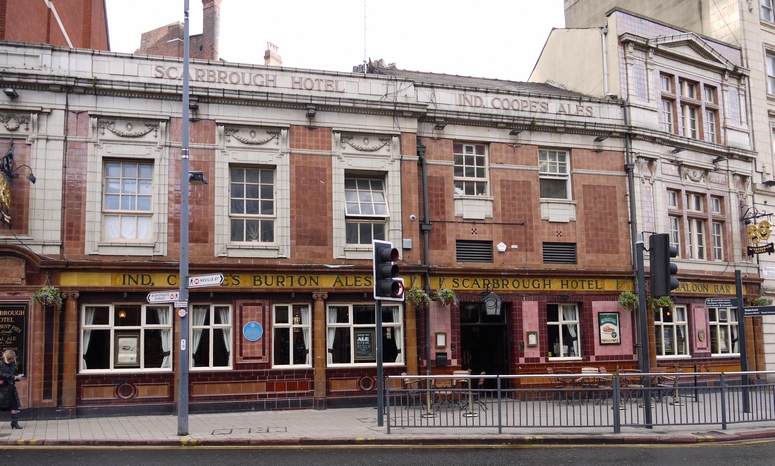
We finished our evening at the Scarborough Hotel pub, which is near the station. It is Victorian pub that is tiled on the outside. This is a great photo:

Scarborough Hotel

If you are into real ale you can see the beer ratings below. There is also a good picture of the pub sign:

Pubs and Beer

I'd like to finish with a short video of a European Eagle Owl and a song by Gerry Rafferty. This is one of Bungle's relatives who lives at the University of Bristol. Here is Oscar doing his daily ablutions:

Oscar

And here's Gerry Rafferty's Night Owl and an interesting yet bizarre image, from the album cover, of Rafferty with his guitar lounging on the back of an owl:

Night Owl

Saturday, 9 January 2010

Leeds Psychogeography Group

I set up Leeds Psychogeography Group in 2009 and it ran till 2012. Talks were held in term time at the University of Leeds and were available to people inside and outside academia. Speakers were invited to talk to the group on a variety of subjects relating to the city, urban space, the Situationists, human/urban/neo-geography, urban walking, local history. During this period we had speakers from many backgrounds, including artists, geographers, writers, urban walkers and film-makers. Walks were also organised on a regular basis. While there are no longer any talks, you can still subscribe to a psychogeography news mailing list and/or join Leeds Psychogeography Group on facebook (see below). I use the mailing list to keep people updated on anything psychogeography related including: conferences and talks; books and films; artworks, walks and performances, etc.

Please note: You are welcome to contact me via my website to go on the mailing list that I maintain for psychogeography related news, or join the group on facebook: Leeds Psychogeography Group