Tuesday, 31 August 2010

Armed for Armley - Part 1


Armed for Armley - Part 1
Leeds Industrial Museum Reconnaissance


In preparation for a psychogeographical expedition with the Design School students at the University of Leeds, I set off on August Bank Holiday Monday to do a 'reccy' of the Leeds Industrial Museum (nee Armley Mills):

Leeds Industrial Museum

Armed with my phone-camera but not my usual notepad, I checked out the online museum map before I left and also took my Leeds A-Z.


Could you tell me where the Industrial Museum is, please?

This museum must be the least well signposted museum in the UK. I did not see one brown signpost denoting cultural-places-of-interest until I was right outside the museum car park which was already well signposted. This may be because most people drive and then you would need to approach the museum from the opposite side than I did. I walked and entered from Kirkstall Rd.


However, do not be put off by the lack of directions for walkers, as it is well worth the doubt once you get there and I have provided directions for you here, if you are walking from Kirkstall Rd. The walk from Kirkstall Rd is interesting and well-worth the psychogeographical experience, so if you drive why not park near the Vue cinema and follow my directions as well.


Mission: Armly Mills

1) Enter Milford Place from Kirkstall Rd - well, I've worked out it was Milford Pace, going by my A-Z, but as you can see from the image below, the road sign seems to be missing. However, don't worry as it is the road opposite the Rising Sun pub and also there is a sign that points to Kirkstall Industrial Estate.


2) You will know you are in the correct road once you see this sign, about half way down on the left:


3) At the end of the road there is a narrow bridge slightly to the left. Here is the view from the bridge:


4) At the other side of the bridge go up the steps to the road:


4) Once you get to street level, turn right across the bridge and keep right. The museum is a few yards along on the right.

5) There is a lane to the right of the car park which leads to the museum.

This plaque is outside the entrance to the museum and so are the painted metal bollards, one of which had a disabled parking sign on:


A Psychogeographer Undercover

It is really cheap to get in, only £3.10 (max) and £1.60 for students! I got in for a student rate but the nice chap at the reception later said that, as I was doing a reccy, I could have got in for nothing. However, £1.60 is a bargain and we need to support our local museums in case the government takes them away from us!

You cannot take photos inside the museum, but do not worry, as by far the best shots for the psychogeographer are outside. I took one photo from the inside, of the fabulous chimney. Here it is alongside a shot of the chimney from the outside, notice the difference in the sky of the two shots, only taken a short while apart:


Engine Room Surveillance

For me the 'Small Engine Room' was by far the most exciting section of the inside museum. Also, it was semi-outside, so I took this to mean I could take photos. The first picture is blurry, but I have kept it in as the machinery itself is so massive and interesting. Please just attach some artistic licence to the blurryness and pretend it was intentional:


This wheel has also come out blurred, but I like it as it looks like it is turning.


Hunslet was an engineering company and also the manufacturer of 'Jack' the steam engine that is located at the museum. Hunslet is also a region of Leeds and the engine company is named after it. The mini steam train is named Jack after Jack Lane, where the engine manufacturer was located in Hunslet.


EMDs: Engines of Mass Production

Here is the wiki page on the Hunslet Engine Company:

Hunslet Engine Company

Another engineering company located in Hunslet was J & H McLaren:

J & H McLaren

Here is a picture I took of Jack, just before he started moving:


This is a blog/website dedicated to the area of Leeds called Hunslet: Hunslet Remembered

The following images are of the engines, or engineering-related equipment, that I took outside. The first one looks like waves made out of iron. The grill is strange-looking but I like it as it has a warp and weft (woven) look about it; very appropriate for a textile mill:


The situating of the the original mill on the Aire, and in particular on a bend where there was fast-moving water, meant that this site was perfect for the wheels that ran the mill. Here is a photo of the river, and some kind of sluice, inside the museum site:


I don't know what this object is, but I like the shape and colour. It also looks like it is being caressed by the ivy:


The nature/culture dichotomy is something I have written about in a previous blog:

The Disinhibition of the Persistence of Gaia

Here is a nice picture of a plant growing in the pointing of a wall on the museum land, along the same lines of the above blog:


Peripheral Observation

The following images are taken on the edge of the museum site, just before the steps that take you down to the river and back to the industrial park. The first picture shows some piping that runs parallel to the bridge that you cross to get to the steps. I like this image, with the pipes in the middle, the bridge one side and the trees the other:


But, I think the following photo is my favourite image of the trip. I'm guessing this wooden outbuilding will either fall down or get pulled down at some point. However, in the meantime it potentially makes for a good composition. I have named it Water Shed:


I also like this roof, with the interesting chimneys and the dilapidated sign:


Homing Device

On the way home I didn't take too many photos as I didn't want to make this blog any longer than it already is. Here is a nice piece of paving(?) in Milford Place. I have called this image Chocolate Pavement:


I bumped into a cat I know from working in the area a few summers ago. Her name is Mimi and here she is on the wall of her garden in Argie Rd. I like it when cats do that arched-back-cat-thing that they do when they rub up against something. Mimi is quite friendly, with a little bit of encouragement, and according to her owners she likes corn snacks:


And, finally, here is a sign outside a convenience store in the Burley area:


I really like these newspaper pull quotes that get placed in signs. I'm guessing this one might well sell some papers as people would be interested to see if Leeds noisiest neighbour lives in their own street or, maybe, if they are indeed Leeds noisiest neighbour!


A Psychogeographer Decommissioned

I enjoyed my mission to Armley Mills and would recommend it to anyone. I consider it to be one of Leeds best kept secrets. I know people who have lived here for years and have never been. Please buy the guide book when you are there, it is under two squid and will help keep the museum going. It also has some lovely images in it and a concise history of the mill. Also, coffee/tea is only 75p, although it is help yourself. I think you can take your own picnics and eat outside.

The area surrounding the mill is particularly interesting for psychogeographers as it runs along the River Aire and the Leeds and Liverpool Canal. These waterside areas often contain signs of our industrial past (and often present) and also conceal all those interesting liminal spaces. For a previous blog in the same area please click here:
Kirsktall Valley Subdub or The Prozac Walk

I would like to conclude with some quotes from the psychogeographer Iain Sinclair. They are very pertinent to how psychogeography can reveal the history in the palimpsest postmodern urban landscape. He states that the most hackneyed of objects appear intriguing when examined from a new perspective:
“These sites, come upon by accident, prick our imagination, provoke reverie.”
“When you don't see it, it is still there. And when you do, it is on the point of disappearance.”
From: 'A world you never new', 'Secret Britain', The Guardian, April 2009

Saturday, 28 August 2010

Paths to Romance: A Psychogeographer Walks to Wuthering Heights

Last weekend I went up to Top Withins. As a true 'psychogeographer' should, I took photos of the signs. The following are the ones from the closest car park up to Top Withins itself. For anyone who doesn’t know, the walk begins very near to the village of Stanbury, which interestingly has as its Wiki page an image of a speed restriction sign:

Stanbury

Here is the wiki page on Top Withins. I love the fact the the sheep appears to have posed for the photo: Top Withens on Wiki

The first two signs I photographed are relatively early on in the walk. They are both stating that it is a private road and highlight the restrictions. They look like they emanate from different origins, even though they have the same text. The second one states that it is from Yorkshire Water and one can recognise the logo on it:


The following one was on a gate, saying that the camp site was closed. It is the 'height of summer' so I was a bit surprised, but I guess there could be many reasons why it was closed:


The next one was a nice carved stone for Upper Heights Farm:


This lovely old wooden signpost looks great against the blue sky. Notice the Japanese(?) text:


The final sign I photographed is the one on the wall of Top Withins itself. Placed by the Bronte Society in 1964:


There were lots of people at Top Withins, many more than were there when I used to go in the 1970s. However, I was impressed at how well kept the area was: no rubbish at all, and it looked the same as it did 35 years ago.

Please see below for relevant links:
Photo of Top Withins
Bronte Parsonage Museum and Society
Wuthering Heights by Emily Bronte

Tuesday, 24 August 2010

The Headingley Hole

A hole appeared in Headingley High Street today. I'm not sure if it leads to Hades or Atlantis, but the workmen found it when digging, rather than it being discovered by a surprised motorist while driving over it. I spoke to them and they let me take photos:


Apparently the workmen simply found a "void" when they were digging for the purpose of working on utility pipes.

You can only drive one way along the High Street and cannot enter from the lower side of Headingley.

Here is the traffic report from BBC online:

Headingley road hole causes traffic delays

The Disinhibition of the Persistence of Gaia or Nature Finds a Way

During the Owl Trail Walk, which the Leeds Psychogeography did on July 27th, we spotted a number of plants emerging out of the brickwork of the buildings in Leeds. Mark Jaffe took some great photos of these, despite the fact that some were many floors up from street level:


I love these images and am always fascinated about how it is that despite man's attempts (intentional or not) to silence life, it manages to find a way. Deleuze and Guattari talk about this when discussing the 'molecular' and they give an example of a particular rhizomatic nettle plant that can work its way through a wall, a molecule at a time.

Here is a really nice film that Gregory Reveret has made on the subject:

Nature Finds a Way

I'm always reminded of Chernobyl when I see plants emerging through some seemingly impervious material. I saw an amazing documentary on TV of how Chernobyl looks today. Here is a photo that I found online:

Nature Consumes Radioactive Chernobyl

It literally looks like a frozen moment in time. You can almost hear the fairground noise and see the people having fun driving into each other in the bumper cars.

This image is particularly interesting for a number of reasons, not least because it shows a place of 'pleasure': a fairground in a region that subsequently has the notion of 'tragedy', even 'horror', attached to it. I would love to do a psychogeographical project at Chernobyl. If any funding bodies out there are reading this, please contact me.

Wednesday, 18 August 2010

Wish You Were Here!


On August 4th 2010 I bought a postcard from the Beach Cafe in Old Hunstanton and sent it to myself at my university address. I chose a 'typical' seaside image: a sunny day with people enjoying themselves on the beach. It turns out the image was from the 1970s at the latest, as the photographer had to have been standing on the pier. The pier was originally built in 1870 and destroyed by a storm in 1978.


The Wish You Were Here Concept
While wikipedia has a whole section on the Pink Floyd album of the same name, it doesn't have a section on the concept. This might be because it is obvious or because it merits its very own thesis. However, Jacques Derrida has written about the postcard in The Post Card: From Socrates to Freud and Beyond, and other philosophical texts seem to be available on discussions of the postcard, but not much on wish-you-were-here.


The Postcard as Sign
In Britain the seaside postcard is synonymous with the rise of the Victorian seaside resort. According to the OED a postcard is "A card designed to be carried by post without an envelope". However, the holiday postcard is much more than that. Amongst other things it is a sign of remembering and a recognition of absence. While this could also be applied to a letter, I think the holiday postcard has a different kind of significance: it is celebrating the pleasure of the sender in the absence of the receiver.


Reading the Arcades/Reading the Promenades
This mini-blog is part of the above project. All my seaside schizocartography posts are available here:
Reading the Arcades/Reading the Promenades

Or click here to link to my previous blog on the Norfolk seaside resort of Hunstanton:
A Strange Psychogeography

Wednesday, 11 August 2010

An Unconventional Leeds Owl Trail


(thanks to Leeds Owl Trail for the above image)

Tuesday July 27th 7.00pm. Members of the Leeds Psychogeography Group (10 of us in total) set off from the steps of the Civic Hall in Millennium Square, Leeds. We were following the established walk created by the Leeds Owl Trail group.

This blog is a subjective response to findings on the walk, not necessarily of an owl(ine) character, but rather more psychogeographical. It in no way replaces the brilliant trail charted by Leeds Owl Trail group who can be found here:

Leeds Owl Trail


Byelaws...Schmyelaws

We started our trail in Millennium Square, home of the big golden civic owls that are so familiar to Leeds citizens and visitors. As you can see from the image below, a sign on the edge of Millennium Square has a long list of byelaws attributed to this public space:


The link below takes you to the Leeds City Council byelaws for public spaces. It's 60 pages long. However, it does have a nice image of the Leeds coat of arms – and obviously our lovely Leeds owls – on the front cover.

Byelaws for Pleasure Grounds, Public Walks and Open Spaces

I scanned through the contents page to find the most interesting restrictions. This is what it says under 'missiles':

“No person shall throw or use any device to propel or discharge in the ground any object which is liable to cause injury to any other person.”

And 'grazing':

“No person shall without the consent of the Council turn out or permit any animal for which he is responsible to graze in the ground.”


Blue Plaques

I photographed two blue plaques on the walk. The first one was for Samuel Smiles and was outside the museum:


It seems Samuel Smiles, despite being a Victorian, wrote some quite hippyish books, one, in fact, called Self Help. According to wikipedia he was the editor of Leeds Times and was a supporter of women's suffrage. So, an all round good egg who probably could well have been a hippy before his time.

The other plaque was outside the Quebecs Hotel, a lovely building of red brick. It had previously been the Leeds and County Liberal Club. The very kind concierge let us go in and look at the owls on the stained glass window on the fabulous staircase.


According to wikipedia Quebecs Hotel is a Grade II listed building. It seems to be a 'boutique' hotel and the reviews look excellent. The interior is lovely. Apparently it was voted by the independent in 2007 as one of the best 50 British Hotels. I wonder if they have a public bar:

Quebecs Hotel - Review

Here is a good picture of the foyer I found online:

Quebecs Hotel - Foyer


An Owls Eye View of Leeds

Since this was an Owl Trail I feel I should include the only two relatively good photos that I pulled off my phone. The first one was in Millennium Square.


The one below was on the fence outside the library in Calverley Street. These owls were all along the fencing on that side of the building


Apparently there are real owls at Leeds Royal Armouries. According to the website they have an Eagle Owl and an African Spotted Owl.

Birds of Prey at Leeds Royal Armouries

I typed 'Bungle' in to the Leeds Royal Armouries search engine to see if I could find the owl that is mentioned on the Owl Trail site, but nothing came up. I do hope this doesn't mean that the lovely Bungle has gone to the great owl barn in the sky. Bungle is a European Eagle Owl, so I think he must be the one mentioned on the Royal Armouries site. Here is a picture of Bungle looking very proud:

Bungle

According to the Leeds Owl Trail site Bungle likes: “To have a bath and he bathes himself by splashing around in water” and spends 5 months of the year chilling out while waiting for the season to start again at the Royal Armouries. It's alright for some...


The Leeds Tapestry

Leeds has its own tapestry in the Leeds Central Library: Leeds Tapestry 2000 http://www.leedstapestry.org.uk/index.php. It consists of a number of tapestries made by the local community. The tapestries are beautiful and must have taken a great many hours and much care to create:

Leeds Tapestry 2000

Here is Barbara Walker's blog on the Leeds Tapestries:

Leeds Tapestry Blog

Barbara has kindly given me permission to include the following owl images from her site:


Good Night Owl

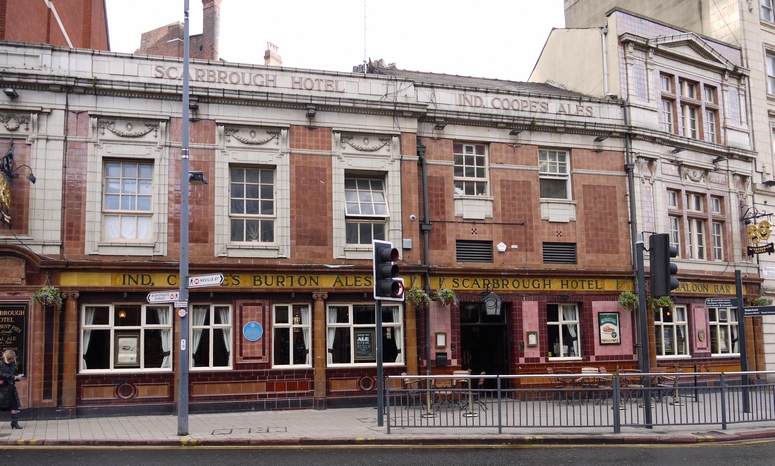
We finished our evening at the Scarborough Hotel pub, which is near the station. It is Victorian pub that is tiled on the outside. This is a great photo:

Scarborough Hotel

If you are into real ale you can see the beer ratings below. There is also a good picture of the pub sign:

Pubs and Beer

I'd like to finish with a short video of a European Eagle Owl and a song by Gerry Rafferty. This is one of Bungle's relatives who lives at the University of Bristol. Here is Oscar doing his daily ablutions:

Oscar

And here's Gerry Rafferty's Night Owl and an interesting yet bizarre image, from the album cover, of Rafferty with his guitar lounging on the back of an owl:

Night Owl

Tuesday, 10 August 2010

The Civic University

While it is not easy to separate the concepts behind the civic university movement from a discussion on the British Red Brick universities I shall begin by looking at the lineage of the civic universities in order to situate the Red Bricks within that movement. I will take a separate look at the Red Bricks in the following section.

The term 'civic' is tied in with the ideas of good citizenship; processes for citizen engagement with policy; a healthy democracy; community participation; knowledge transfer and skills education. In the foreword to Richard Pratte's book, The Civic Imperative: Examining the Need for Civic Education (1988), Jonas F. Soltis defines American civic education as “the conveying of unique meaning, obligations, and virtues of citizenship” which means that “the younger generation will be able to join their elders in a meaningful form of unique group life that is permeated by a particular set of binding and guiding values.” (1988: vii). A contemporary definition of British civic education is provided by the Office of the Deputy Prime Minister, 2005: “educational, learning or promotional activities carried out in a local context by or on behalf of local councils, to enable people to become more involved in democratic processes.” (Andrews and Cowell 2005: preface).

The definitions of what a civic university is are broad and clearly tied in with the notion of what civic education stands for. Also, definitions differ slightly in the time period they represent and in regards to the particular appeals for engagement that reflect the policy of that moment. For example, in 'English Civic Universities and the Myth of Decline' (1992) Elizabeth J. Morse provides an example of a specific post World War I request for civic support based on a forward-looking university model that is also considerate of the catastrophic events of the previous war: “the idea of a civic university, situated in the heart of a great city, oriented toward the practical and the modern, is enunciated, together with a reassurance that the modern university can combine modernity with a respectful sense of the past.” (1992: 189). In his published thesis The Origins of Civic Universities: Manchester, Leeds and Liverpool (1983) David Robert Jones uses a definition that orients the civic universities in the preceding civic colleges: a refocusing of curriculum based on the demands of society that move away from the more traditional subjects like classics and mathematics offered by Oxford and Cambridge (1983: 4).

W. H. G. Armytage's Civic Universities: Aspects of a British Tradition (1955) provides a detailed history of the universities going back to what he calls the “Monastic Matrix”, thus situating their origins within the faith tradition. Armytage is considered by many to be an authority on the civic universities, although some academics do not agree with everything he writes. Texts by other historians look to Ancient Greece as a starting point due the notion of 'civic' being attached to ideas of a 'good society'. For the purposes of this thesis I shall briefly highlight the lineage provided by Armytage up to the point he discusses the rise of corporate patronage (1731-1810) and will look in more detail at the history of the civic universities from that point onwards, incorporating other texts, in order to lay the foundations for the Victorian period and its focus on British industry and the rise of the Red Bricks.

What Armytage describes as the “Monastic Matrix” (596-1154) focused on the attempts of clerics to save culture and education from the legacy of the Roman Empire. However, during this period efforts were also made by the crown to 'civilise' the titled enforcers of the laws of England, in order to instruct them to preserve the culture of the country. The latter part of this period involved the world travel of monks wherein they would both be educating themselves and also engaging others in English culture. (Armytage 1955: 15-30).

“Close and College: Premature Regional Universities in England” covers the period from 1154 to 1334. Armytage explains how secularism (a separation of government from religious policy-making) encourages variety in the forms of education available to scholars and the administrators of public office. Formalised schools sprung up in these secular cathedrals in some English cities that were comparable to universities, such as Lincoln and Exeter. This period also involved the emergence of Oxford and Cambridge universities along with a legal declaration that no more universities would be permitted. (Armytage 1955: 31-47).

Armytage calls the period from 1334 to 1546 “Laicisation1 of the Professions and the Concentration of the Collegiate Effort”. During this time many local colleges emerged around the country and Oxford and Cambridge were permitted additional colleges in their respective cities. University teachers were given more freedom to move about geographically. Also, schools dedicated to law, Inns of Court, opened up in London. During this period the number of hospitals increased exponentially, highlighting the need for improved medical skills and professional training for medics in a number of areas, such as the arts. It was thought that this would enable surgeons to become more eloquent and also improve their status in relation to other professions, such as the clergy. (Armytage 1955: 48-65).

“The Emergence of Scientific Spirit: 1546-1600” spawned a focus on humans and their environment which resulted in a new approach to education. Armytage explains how this enabled subjects like literature and science to be studied in specially designated royal colleges run by the most highly regarded academics. Medicine became a singular subject at Oxford and Cambridge and anatomy became an important focus. The study of mental life also became popular. Scientific classification became the bon mot and heralded the Age of Enlightenment to come: categorisation in the area of natural history was being developed and would become apparent in the following era with works such as those by Immanuel Kant and René Descartes. According to Armytage, mathematics now became a “cultural force” (1955: 73) helped by translations of some of the ancient Greek texts. University reform was also carried out during this period with a rationalisation of subjects by creating specialist colleges. The mercantilist aims to efficiently extract and process raw materials also meant that new technologies were required and the need for educated users of those tools. This meant that learning a trade became vital for the country's workers and resulted in apprenticeships. With the dissolution of the monasteries that had preceded this period, it became the responsibility of newly formed secular organisations to respond to the changing needs of a fast-evolving society. (Armytage 1955: 66-93).

“The Baconian Blueprint” covers 1600 to 1660. Armytage cites Sir Francis Bacon's Novum Organum (1620) as representing the philosophical break with the past that required a new revolution in thinking about knowledge. Bacon challenged the very foundation of current educational practices, the educators and often the scientific texts themselves. During this period the first discussions of a Northern University began, however these were scuppered at this time. A university in London was also considered. Neither of these came about at this time for political reasons oriented in regional power. The new philosophical outlook of the Enlightenment enabled a more democratic ideology to emerge around the concepts of education for all, the liberalist view of education. It was also the case that some believed that the traditional arts subjects led to idleness whereas technological training did not. Cromwell believed that the poor, who he had little cultural regard for, would benefit from an education. Following the dissolution of the cathedrals and their related colleges in Durham, the city demanded their own college, which was eventually granted in 1657. However, during this same period Oxford and Cambridge were fighting for their life due to a movement in Parliament to dissolve them due to a dislike of the make up of the faculties at both sites. Cromwell put a stop to this dissent. (Armytage 1955: 93-116).

The final period that I will provide in this summary of Armytage's timeline is what he calls “The Royal Society and its Influence” (1660-1731). This time-frame looks at the impact of the Royal Society, which grew out of the need for both university reform, research and the sharing of knowledge, and was comprised of academics from around the country. During the Restoration both students and academics were required to take religious tests and lost their jobs or educational places if they did not. This resulted in many significant academics losing their posts and a decline in the eduction and administration of the universities and colleges (these rejected academics later set up 'academies' for those members of the gentry who did not want to send their sons to these failing universities). The Royal Society had a big task ahead and did not always find co-operation in the various agencies they worked with. It appears that Charles II did not give the Royal Society the power they needed to carry through the change they hoped for. Despite these difficulties, the Society survived and with it the understanding that these types of bodies were important, if not essential. The academies became successful and began to become official institutions with established specialisms. (Armytage 1955: 117-142).

The politics that followed set the scene for the major developments in industrialisation that came about during the Victorian period. Mercantilism dominated Europe up until the 18th century, creating a particular class of citizen: relatively wealthy merchants who traded commodities nationally and internationally. As an economic model mercantilism focused governments and their merchants on systems of international exchange that often appeared to cancel each other out. However, it became apparent that skills were required to enable raw materials to be finished to such a standard that they could then be sold on, with good profits coming out of this process. Trade bodies and manufacturing associations, along with craft and professional bodies came into their own.

In 1773 the Medical Society of London was formed and following this provincial hospitals appeared around the country, for example, in Leeds in 1767. The Leeds School of Medicine was established in 1831. The civic universities that followed this period all grew out of the existing medical schools (attached to hospitals), and technological colleges that were situated, in particular, in the industrial cities of England. The technical schools were essential for the continuing economic growth of colonial Victorian Britain. Jones explains: “Mid-Victorian society was rearranging its institutions and creating new ones to serve a changing and growing variety of needs and people.” (1983: 34). While the new Education Act of 1870 concentrated on the education of the young, it was driven by the need to keep Britain competitive in the international arena. This followed the poorly received British exhibits at the Paris Exhibition of 1867 (Armytage 1955: 219), especially those of Yorkshire industry (Sanderson 1988: 94).

M. Sanderson deals specifically with this period of industrialisation. In 'The English Civic Universities and the “Industrial Spirit”, 1870-1914' (1988) he analyses the civic universities in the context of the ideology of the time. Sanderson discusses the creation of various colleges by eminent industrialists and the successes and failures of these: “Those civic universities located in industrial regions, gaining the support of the business classes and reflecting their interests and spirit flourished. Those that did not, did not.” (1988: 93).

The Yorkshire College of Science was set up in Leeds as a response to the damning Paris Exhibition response:
"It was hoped that such a college would raise the level of science and education and thereby heighten the competitive capacity of the textile industry in particular. As the college said, its purpose 'is intended to supply an urgent and recognized want, viz, instruction in the sciences which are applicable to the Industrial Arts'" (Sanderson 1988: 94).


Armytage discusses the influence of Matthew Arnold in promoting provincial colleges. Arnold considered it vital to have local centres, in the form of faculties, in key areas of the country, enabling people to gain a local education outside of Oxford and Cambridge (Armytage 1955: 220). As well as the new Yorkshire College of Science, The Leeds Art and Science Institution was established in 1867. Many local industrialists were behind the project, including Edward Baines, the radical newspaper editor2 - who was also a benefactor of the new Leeds college, the Yorkshire College of Science (Armytage 1955: 221).

According to Sanderson, the notion of 'industrial spirit' continued well into the the early 20th century, with a positive focus on vocation and a de-emphasis of the model of liberal education of the past. Sanderson provides an example of the fictional text by George Gissing - Born in Exile3 - (1892) - that he believes sums up the Zeitgeist of the period. Sanderson says: “Here was the true civic university ethos – rooted in its region, supported by and regarded with pride by its business community, academic values linked with, and not divorced from, those of capitalism, science and the economy.” (1988: 96). While the the word 'exile' in the title of Gissing's novel deals with social exile rather than being exiled from one's own country, it is not quite so clear-cut as this, because the protagonist migrates South away from his Yorkshire homeland.

The notion of migration could be considered in regards to the Humboldtian influence of the German university model of Wilhelm von Humboldt (1767-1835). While Armytage makes no reference to Humboldt in his book, many consider Humboldt to be influential in European universities in general, at least up until the end of World War I when many traditional views about society, politics and the lived experience had to be reconsidered. However, other critics consider that some of the Humboldtian influences did not filter through to the British universities until later in the 20th century, influencing the promotion of league tables (for example, Robert Anderson). The Humboldtian model, based on that originating at the University of Berlin, focused on research; an integrated community spirit between both students and scholars; and professionalism and contributions to industrial advancement. The Humboldt model will be revisited in discussions on the Red Brick universities and their relation to the industrial cities in which they evolved.

As Jones explains, the civic universities did not show the “anti-commercial bias” that the ancient universities did, or those modelled on them, such as Oxford and Cambridge (1983: 71). Victorian Britain lay the foundations for the civic universities to arise out of the technical provincial colleges. In the next section I will be looking at the Red Brick universities within the context of the civic university model, in particular the northern universities and specifically the birth of the University of Leeds out of the Yorkshire College of Science and the Leeds School of Medicine.


References
Andrew, Rhys and Richard Cowell. 2005. Civic Education and Local Government: A Literature Review (London: ODPM Publications).

Armytage, W. H. G. 1955. Civic Universities: Aspects of a British Tradition (London: Ernest Benn Ltd).

Morse, Elizabeth, J. 'English Civic Universities and the Myth of Decline', History of Universities, 11 (1992), 177-204.

Pratt, Richard. 1988. The Civic Imperative: Examining the Need for Civic Education (London and New York: The Teachers Press).

Sanderson, V. 'The English Civic Universities and the Industrial Spirit 1870-1914', Historical Research, 61, 144 (1988), 90-104.