Showing posts with label Hunstanton. Show all posts

Sunday, 15 October 2023

Hunstanton: Wish You Were Here!


My latest zine is out. It's a psychogeography of the seaside town Hunstanton, in Norfolk. Here's the text from the prologue: 
I know this is a cliché, but this booklet is a kind of love letter to Hunstanton: one that is deeply influenced by both my childhood (being a progeny of King’s Lynn) and the nostalgia of my late teens and early twenties, when me and my peer group used to socialise here. This is way before Hunstanton became the ‘posh’ seaside town it now is. This text is both a celebration and lament. How can it be both, you may well ask. I left King’s Lynn, for London, in 1987 and I returned to Hunstanton in 2022 due to an unexpected change in my personal circumstances. This is the story of that journey: from the standpoint of a person whose perspective has changed. Moreover, also the space that is being explored has changed…


Description and Price:
The A5 hard copy zine is in black and white with photos of Hunstanton and other related images. It also includes some academic analysis. The cover is made of yellow card and the zine is photocopied and professionally trimmed and stapled, retailing at £5.50 plus postage (UK is standard letter). The appendix includes a map, a collage and a poem.
A digital colour copy is now also available at £4.00 and can be provided via email.

Note: This is a Limited Edition hard copy run and consists of a run of only 25. No more will be printed when these have all gone.


Sunday, 10 June 2012

Cutting up Space, Part 1: L = S - [l + c + i = e + p]


As a psychogeographer I am particularly interested in pieces of land that appear to be waiting for something to happen. These can be owned by either the local council or a property developer and can be in abeyance for many reasons, including land-sitting (buying property to stop someone else buying it, or buying land speculatively). Sometimes, in the case of local councils, funding might have run out and the land development halted. Rarely, are they owned by individuals, although there are cases of private houses being left vacant, as has appeared on the news recently.

The land in the image above is off Low Lane, Horsforth, Leeds, and I think it might be waiting for further development in relationship to the future Woodside Railway Station in Horsforth, although I'm not certain.

This strange liminal space is in Hunstanton, Norfolk (below), is just off the promenade, but is easy to miss. Who does it belong to? Was it part of someone's garden? Do the council own it?


Philip Kivell's book 'Land and the City' is a really interesting book and discusses these issues:

He introduces a neat formula that is used in calculating land value which is dependant on the market value of existing properties in the local area:


L = S - [l + c + i = e + p]


Where:
L = developer's bid price for the land
S = anticipated selling price of completed development
l = estimated land preparation and infrastructure costs
c = estimated construction costs
i = estimated interest charges on land and construction costs
e = estimated legal and marketing costs
p = estimated developer's profits

There is a lot of development going on in the Holbeck area of Leeds, although it has somewhat come to a halt recently; for instance, the demolition of the terraced houses in one particular area. The satellite map below shows the rows of terraced houses that are under threat. It is not easy to see, because the road names block the view of the actual streets, but some of the terraces have already been pulled down. A local solicitor told me that the only reason that the demolition has stopped is because the council ran out of money.


Local councils acquire space currently used for private housing through Compulsory Purchase Orders. They just need to have a 'good reason' to do this, invariably economic, and it can be done with little recourse. The laws in this regard changed in the 1980s and became vaguer in relation to urban policy. This meant that just about anything could be done under the aegis of adding economic value to a region. We can thank Margaret Thatcher for this. Anna Minton writes about it in her book Ground Control

Kivell comments on land speculation when discussing power in relation to acquisition. He remarks that some critics of it claim that it "provoked the 1974 recession through an unbalanced flow of land onto the markets, the distortion of production costs of firms and the reduction in the spending power of households." (p. 131). I have heard this theory from other sources, too.

While Kivell does not talk philosophically about the cutting up of space (this is not his field), he does talk about zoning: the demarcation of space by the State for specific purposes. I think G. Spencer Brown's Laws of Form may be a useful way to approach this, coupled with deconstruction, so Part 2 of the blog will investigate the cutting up of space from that perspective.


Please click here for part 2 of this blog:

The following links may be of interest:
What else could go here?
Student farm in Brooklyn

Saturday, 17 December 2011

The Carrstone Affect

Hunstanton's Historic Buildings

During the wintery months, any visitor not wishing to brave the blustery beaches of Hunstanton with it's freezing winds, might like to take a walk around some of the town's notable historical buildings. This blog highlights some of those known in the town, three of which display Civic Society coloured plaques. For those of you not familiar with the area, please note the honey-coloured bricks that many of the buildings are made of. It is a sandstone known locally as Carrstone.

Valentine Court


According to Jim Whelam, writing in the Hunstanton Newsletter:
The establishment of a convalescent home at Hunstanton was first suggested in 1869 in Ely Cathedral, so that sick and poor people from Ely could recover their health with the assistance of sea air . . . The Prince and Princess of Wales agreed to officially open the home on Easter Monday, 14th April 1879. As soon as the date was known, all the villages between Sandringham and Hunstanton began making preparations on a grand scale to honour the visit. During the Easter weekend the weather was foul with keen east winds, rain and snow. The day of the visit commenced with a dull leaden sky, no apparent sign of an improvement, and not even the numerous decorations could make Hunstanton look anything less than miserable. However by noon the clouds lifted and the sun shone, crowds gathered, the railway brought in 3,000 visitors and thousands of others entered by road.
Now a block of flats, the building appears on google searches mostly under property sales. Jim Whelam's account in the local newsletter is really interesting and can be read here:
The Royal Opening of Hunstanton Convalescent Home

Old Police Station


This old police station is great. It just looks like a 'regular' terraced house. However from 1875 to 1954 it was Hunstanton's police station. I wonder if the three cells were in the basement. One can only assume that crime was a relatively minor issue in Britain until the mid 50s, as the current police station, on the main road, is pretty big in comparison.

Children's Recovery Home


Health, for the Victorians was a major concern, some would say even an obsession, and the seaside was a perfect place for convalescing. This, once, children's recovery home is now the council offices for the town. Now that our children are not dying of diphtheria, tuberculosis and typhus these old Victorian buildings are put to other uses. I don't have the mortality figures handy for Hunstanton, but in Leeds in 1867 most people who died were 4 years old and under, and in one book I have - To prove I'm Not Forgot - Living and Dying in a Victorian City by Sylvia M. Barnard - the under one's were classed separately, because their chances of living beyond one year old was so slim.

The Old Vicarage


This is the old vicarage and is located in Northgate, at the town end of the street. Again, it is now apartments and it is difficult to find information on it online other than that on estate agents sites. However, I have included another photo of the building (below). This type of architectural detail is very popular in Hunstanton, and manifests in various forms on a number of buildings.


Often this kind of inlay appears in a square shape, which produces a tiling effect. I really like it and I wonder if it is a common style from that period that was produced mostly in this area, or whether it is more generic.

My little psychogeographico-historical trip around Hunstanton was interesting. The more time I spend in the town looking at the architecture and soaking up the ambience, the more I get in touch with its aesthetic, which feels like it is very particular to the area.

For information on my other work on Hunstanton please go to: Reading the Arcades/Reading the Promenades and look for the links for Hunstanton

Links:
Hunstanton Civic Society

Wednesday, 6 July 2011

Giant Ghost Sheep Eats Unsuspecting Tourists in Norfolk Coastal Town


I took this superimposed image with my Lomo Diana F+ on a recent trip to Hunstanton in Norfolk. The giant sheep statue stands outside a cafe in St Edmunds Terrace. The results exceeded my expectation as it is difficult to get the exposure right on both images.

For my 'proper' work on the schizocartography of Hunstanton, please click here: Reading the Arcades/Reading the Promenades

Wednesday, 23 March 2011

Have You Ever Been to Seahenge? or a Tenuous Homage to Spinal Tap

In Boston Square, Hunstanton, Norfolk, is a sensory park commissioned by Norfolk County Council and designed by Jeremey Stacey Architects. In the park is what looks like a homage to Seahenge which is a prehistoric structure that was found off the coast of Holme-next-the-Sea: a timber circle from the Bronze Age. It was discovered in 1998 and now resides in Lynn Museum. Here is a video I took in the sensory park, and it is my homage to the Stonehenge scene in This is Spinal Tap (1984), directed by Rob Reiner:

Boston Square Sensory Park

Below is the script from This is Spinal Tap, where it refers to Stonehenge (one of the funniest scenes in the film), including a link to the relevant section in the film:

Ian: Are you telling me that this is it? This is scenery? Have you ever been to Stonehenge?
Artist: No, I haven't been to Stonehenge.
Ian: The triptychs are...the triptychs are twenty feet high. You can stand four men up them!
Artist: Ian, I was...I was...I was supposed to build it eighteen inches high.
Ian: This is insane. This isn't a piece of scenery.
Artist: Look, look. Look, this is what I was asked to build. Eighteen inches. Right here, it specified eighteen inches. I was given this napkin, I mean...
Ian: Forget this! Fuck the napkin!!!

SPINAL TAP performs Stonehenge
(click here for film clip This is Spinal Tap )

HOTEL room after gig

David: I do not, for one, think that the problem was that the band was down. I think that the problem may have been...that there was a Stonehenge monument on the stage that was in danger of being crushed by a dwarf...

Related Links
Seahenge
Stonehenge
This is Spinal Tap

Sunday, 6 March 2011

Walking to the Beach


Video: Walking to the Beach

Walking affirms, suspects, tries out, transgresses respects, etc., the trajectories it "speaks". All the modalities sing a part in this chorus, changing from step to step, stepping in through proportions, sequences, and intensities which vary according to the time, the path taken and the weather. These enunciatory operations are of an unlimited diversity. They therefore cannot be reduced to their graphic trail. (De Certeau 2006: 99)


Reading the Arcades/Reading the Promenades
This mini-blog is part of the above project. All my seaside schizocartography posts are available here:
Reading the Arcades/Reading the Promenades
Or click here to link to my previous blog on the Norfolk seaside resort of Hunstanton: The Seaside in Winter

Bibliography
De Certeau, Michel. 2006. 'Walking in the City', The Practice of Everyday Life, trans. by Steven Rendall (Berkeley, Los Angeles and London: University of California Press) pp. 91-110

Thursday, 11 November 2010

A Journey Around My Church


This appeared in the Lynn News on June 18th 1870:

After much consideration it has been determined by a few Christians resident in the neighbourhood to erect a chapel with schoolrooms at Hunstanton, a pleasant village and bathing place on the North Norfolk Coast...Up to the present time no place has been erected for Nonconformist Worship in Hunstanton or within easy walking distance...The Lord of the manor has very kindly granted a most eligible site for the proposed building, and plans have been prepared to secure accommodation for 300 persons in the chapel, and for 200 children in the classroom, at a cost of £1000.


Could you do a psychogeographical blog on our church, please?

A few weeks ago Rev. David Hulse asked me to do a blog, along the lines of those I usually do on Hunstanton for the Reading the Arcades/Reading the Promenades project, on the Union Church. As a psychogeographer, I usually look at outside space, so I decided that I would simply treat this project as if I were walking in an urban area and take photos of the objects I normally do: notices, interesting patterns, curious phenomenon, and the types of objects that often go unnoticed.


I have named this blog after the book by Xavier de Maistre A Journey Around My Room (1794). While the Union Church isn't really my church, it is the nearest to a church that I have and I always visit the Wednesday coffee morning when I stay in Hunstanton:


I/You/We Were Here

One of the experiences of walking in the town or city is that you are able to see the traces of those who have previously passed through. There are objects in space that are attached to people who have taken a journey. For example, a discarded bus ticket would be an obvious record of a journey that has been temporally and spatially indexed. However, objects often get left accidentally. Here are two umbrellas hanging in the church. The chances are that the day they were left it was raining upon arrival at the church and not on departure.


Also, on the coat hanger I found a hat (the one on the right) - "Is it David's?", I wondered at the time. So, I took off my own hat and placed it on there too and took a photo. The photo now tells a tale and remains as a sign of the day that I went to the church to do this blog: it says "I was here".


David let me go into his office; so, I took a photo of the items on his windowsill. I don't know what the item second from the left is, but it looks interesting.


Repeating Patterns
I took the following photos because I like to look for patterns that are formed by decontextualising objects from their space. Below is Complete Mission Praise, the hymn book used at the church, and also the Christmas presents that the church collects, assembles and sends abroad to children who are not fortunate enough to receive presents.


Human beings look for patterns in their environment. Historically it has been one of the qualities that has enabled us to evolve and survive, for example by recognising human faces, or quickly spotting fruit hanging in trees. When urban walking, I like to look for patterns in discarded objects or find interesting textures in space. See the blog below for more of these images:

The Cootie Catcher Derive or A Walk With Some Really Interesting Dutch Chaps


Religious Accoutrements

Another thing I like to do with psychogeography is find an interesting object, photograph it, and when I am home do some research to find out more about it. In the image below you can see the bible is open on '2 Chronicles'. While most people know the Book of Chronicles is a section of the bible - and, I'm sure many know it includes a history of King Solomon's reign and information on the Babylonian Exile - however it is also the name that many musicians have used for their albums, including Jon and Vangelis, and Rush (which I'm sure you prog rockers out there also know).


I didn't know what these were, so had to ask David. Apparently they are offering bags and are used in the Sunday Services for collecting money for the maintenance of the church. Four people pass the bags around the congregation and return them to the bowl where they are accepted by David with thanks in the form of a prayer.


I also liked this Prayer Requests book. I'm not sure if it is meant for people requesting a particular prayer or for asking for a prayer for a specific person.


Notices

One of the things that psychogeographers often photograph are the notices in urban space. The Oxford English Dictionary says that a 'notice' is: "The act of imparting information, and related senses. Intimation, information, intelligence; a piece of information....to point out to, mention specially to, inform...". Here are some of those in the church:


An Interesting Banner and Flag


This is what David told me when I asked about the above handmade banner:

When I first went to my last Church (Owton Manor Baptist Church), a lady, Mrs Valerie Carr, asked me if she could put up the banner on the occasions when her husband conducted services of Infant Blessing. I took over the duty, but asked her if she would kindly leave the banner in place. She made the banner, which reflects the Bible story of Jesus blessing the children. Val sadly died in 2000. I acquired the banner for Hunstanton Union Church when the Church in Hartlepool had a change of banners.


The above flag is for the Brownies who meet in the church hall. The Brownie organisation was set up by Lord Baden-Powell in 1914 in order to fully represent both genders and all age groups. They were originally called Rosebuds.

Here is some recent information on the Hunstanton Brownies:

Union Church - Brownies Section
Hunstanton Rainbows, Brownies and Guides - Report August 2010


Traces of the Past

While my walk around the church was a rather unconventional psychogeographical trip, I attempted as much as possible to bring a different experience to the space, in the same way that I do when operating in the outdoors of the town or city. Space holds a social history which reflects the lives of people who have lived and worked there. It is easy, when you move through the same space on a regular basis, to not notice some of the décor. This is both because the space has become familiar to us, but it can also be for other reasons.

I hope I have brought a different flavour of the Union Church due to my wanderings. I shall leave you with this final image because it represents what it is that I find interesting about the objects we find in space. These toys are a trace of the lives of children. What it is that I like is the questions that are posed by them: Who did the toys belong to? Were they toys of local children? What are the children doing now?


Relates websites:

The Union Church, Hunstanton
Hunstanton Churches
History and Heritage of Hunstanton

Wednesday, 18 August 2010

Wish You Were Here!


On August 4th 2010 I bought a postcard from the Beach Cafe in Old Hunstanton and sent it to myself at my university address. I chose a 'typical' seaside image: a sunny day with people enjoying themselves on the beach. It turns out the image was from the 1970s at the latest, as the photographer had to have been standing on the pier. The pier was originally built in 1870 and destroyed by a storm in 1978.


The Wish You Were Here Concept
While wikipedia has a whole section on the Pink Floyd album of the same name, it doesn't have a section on the concept. This might be because it is obvious or because it merits its very own thesis. However, Jacques Derrida has written about the postcard in The Post Card: From Socrates to Freud and Beyond, and other philosophical texts seem to be available on discussions of the postcard, but not much on wish-you-were-here.


The Postcard as Sign
In Britain the seaside postcard is synonymous with the rise of the Victorian seaside resort. According to the OED a postcard is "A card designed to be carried by post without an envelope". However, the holiday postcard is much more than that. Amongst other things it is a sign of remembering and a recognition of absence. While this could also be applied to a letter, I think the holiday postcard has a different kind of significance: it is celebrating the pleasure of the sender in the absence of the receiver.


Reading the Arcades/Reading the Promenades
This mini-blog is part of the above project. All my seaside schizocartography posts are available here:
Reading the Arcades/Reading the Promenades

Or click here to link to my previous blog on the Norfolk seaside resort of Hunstanton:
A Strange Psychogeography

Thursday, 1 July 2010

A Psychogeographical Guide to Hunstanton Promenade


Guide Psychogeographique De Hunstanton

“Progress is nothing other than breaking through a field where chance holds sway by creating new conditions more favorable to our purposes.” Guy Debord

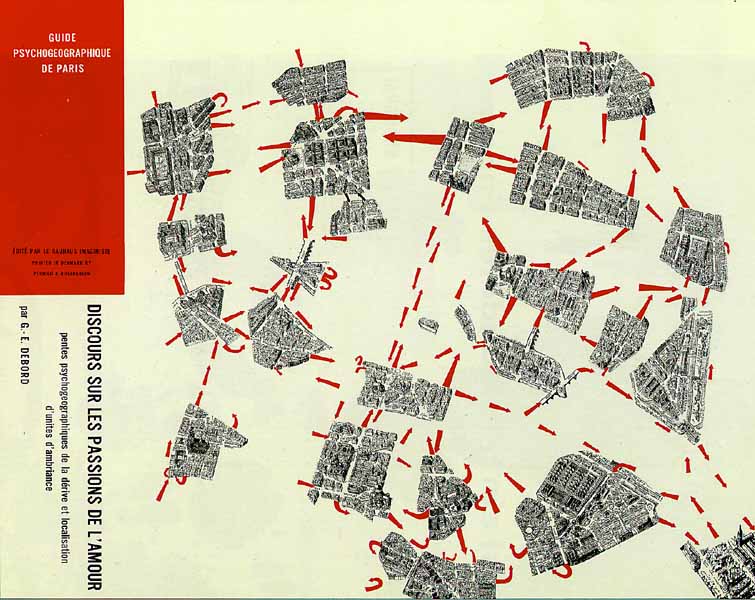
This map is a Situationist-style map based on Guy Debord's 'Guide Psychogeographique De Paris'.

Guide Psychogeographique De Paris

The images highlight various ambiances on the promenade at Hunstanton, Norfolk. The curved line challenges the linear form of the promenade, and suggests an alternative way of walking along the prom (as does starting at the end). The phenomenon represented here do not appear in the order they do in actual space (also, some are transient, some invented e.g. there is no troll). The red of Debord's map has been replaced with blue to reflect the sea. The cream colour, which actually appears in many of the reproduced images of Debord's map, is meant to represent the sand. The text includes: subjective comments, rock music lyrics, popular phrases, a reference to a fairy tale, etc. In this Guide Psychogeographique I have used full colour on the map section, unlike my previous one of the University of Leeds campus, which can be viewed here:

Guide Psychogeographique De University of Leeds

I have noticed an evolution between my first Guide Psychogeographique and the second one and I am interested in seeing how these maps change over time and how far they become removed from the original map of Debord's.

Please note: I would like to give my thanks to those at www.geograph.org.uk who let me use their images. Also, to James Cridland at http://james.cridland.net Much appreciated!

Also, please see my blogs on A Schizocartography of Hunstanton

Bibliography:
Debord, Guy. 1996. 'Theory of the Dérive', Theory of the Dérive and Other Situationist Writings on the City, ed. by Libero Andreotti and Xavier Costa (Barcelona: Museu d'Art Contemporani de Barcelona). pp. 22-27.

Monday, 21 June 2010

The Collage Seaside


“Collage is simultaneously innocent and devious.” Colin Rowe and Red Koetter

The above schizocartographic image was made by cutting photos of Hunstanton from various brochures and leaflets that advertise the seaside town. The pasted words and phrases are mostly popular terms that refer to seaside resorts, but were actually taken from the adverts of businesses or organisations located in the area. The other terms refer to the analysis and theory of urban space and have been added digitally. The quotes are comments on urban space by the following:

1 - Iain Sinclair
2 - Brian Jarvis
3 - Felix Guattari
4 - David Harvey
5 - Henri Lefebvre

This 'map' has been named after the book Collage City by Colin Rowe and Fred Koetter. It has been created for the following project 'Reading the Arcades/Reading the Promenades'.
Please see my blogs on A Schizocartography of Hunstanton located here:
Part 1
Part 2

Bibliography:
Row, Colin and Fred Koetter. 1987. Collage City (Cambridge, Massachusetts: The MIT Press).