Tuesday, 10 August 2010

The Civic University

While it is not easy to separate the concepts behind the civic university movement from a discussion on the British Red Brick universities I shall begin by looking at the lineage of the civic universities in order to situate the Red Bricks within that movement. I will take a separate look at the Red Bricks in the following section.

The term 'civic' is tied in with the ideas of good citizenship; processes for citizen engagement with policy; a healthy democracy; community participation; knowledge transfer and skills education. In the foreword to Richard Pratte's book, The Civic Imperative: Examining the Need for Civic Education (1988), Jonas F. Soltis defines American civic education as “the conveying of unique meaning, obligations, and virtues of citizenship” which means that “the younger generation will be able to join their elders in a meaningful form of unique group life that is permeated by a particular set of binding and guiding values.” (1988: vii). A contemporary definition of British civic education is provided by the Office of the Deputy Prime Minister, 2005: “educational, learning or promotional activities carried out in a local context by or on behalf of local councils, to enable people to become more involved in democratic processes.” (Andrews and Cowell 2005: preface).

The definitions of what a civic university is are broad and clearly tied in with the notion of what civic education stands for. Also, definitions differ slightly in the time period they represent and in regards to the particular appeals for engagement that reflect the policy of that moment. For example, in 'English Civic Universities and the Myth of Decline' (1992) Elizabeth J. Morse provides an example of a specific post World War I request for civic support based on a forward-looking university model that is also considerate of the catastrophic events of the previous war: “the idea of a civic university, situated in the heart of a great city, oriented toward the practical and the modern, is enunciated, together with a reassurance that the modern university can combine modernity with a respectful sense of the past.” (1992: 189). In his published thesis The Origins of Civic Universities: Manchester, Leeds and Liverpool (1983) David Robert Jones uses a definition that orients the civic universities in the preceding civic colleges: a refocusing of curriculum based on the demands of society that move away from the more traditional subjects like classics and mathematics offered by Oxford and Cambridge (1983: 4).

W. H. G. Armytage's Civic Universities: Aspects of a British Tradition (1955) provides a detailed history of the universities going back to what he calls the “Monastic Matrix”, thus situating their origins within the faith tradition. Armytage is considered by many to be an authority on the civic universities, although some academics do not agree with everything he writes. Texts by other historians look to Ancient Greece as a starting point due the notion of 'civic' being attached to ideas of a 'good society'. For the purposes of this thesis I shall briefly highlight the lineage provided by Armytage up to the point he discusses the rise of corporate patronage (1731-1810) and will look in more detail at the history of the civic universities from that point onwards, incorporating other texts, in order to lay the foundations for the Victorian period and its focus on British industry and the rise of the Red Bricks.

What Armytage describes as the “Monastic Matrix” (596-1154) focused on the attempts of clerics to save culture and education from the legacy of the Roman Empire. However, during this period efforts were also made by the crown to 'civilise' the titled enforcers of the laws of England, in order to instruct them to preserve the culture of the country. The latter part of this period involved the world travel of monks wherein they would both be educating themselves and also engaging others in English culture. (Armytage 1955: 15-30).

“Close and College: Premature Regional Universities in England” covers the period from 1154 to 1334. Armytage explains how secularism (a separation of government from religious policy-making) encourages variety in the forms of education available to scholars and the administrators of public office. Formalised schools sprung up in these secular cathedrals in some English cities that were comparable to universities, such as Lincoln and Exeter. This period also involved the emergence of Oxford and Cambridge universities along with a legal declaration that no more universities would be permitted. (Armytage 1955: 31-47).

Armytage calls the period from 1334 to 1546 “Laicisation1 of the Professions and the Concentration of the Collegiate Effort”. During this time many local colleges emerged around the country and Oxford and Cambridge were permitted additional colleges in their respective cities. University teachers were given more freedom to move about geographically. Also, schools dedicated to law, Inns of Court, opened up in London. During this period the number of hospitals increased exponentially, highlighting the need for improved medical skills and professional training for medics in a number of areas, such as the arts. It was thought that this would enable surgeons to become more eloquent and also improve their status in relation to other professions, such as the clergy. (Armytage 1955: 48-65).

“The Emergence of Scientific Spirit: 1546-1600” spawned a focus on humans and their environment which resulted in a new approach to education. Armytage explains how this enabled subjects like literature and science to be studied in specially designated royal colleges run by the most highly regarded academics. Medicine became a singular subject at Oxford and Cambridge and anatomy became an important focus. The study of mental life also became popular. Scientific classification became the bon mot and heralded the Age of Enlightenment to come: categorisation in the area of natural history was being developed and would become apparent in the following era with works such as those by Immanuel Kant and René Descartes. According to Armytage, mathematics now became a “cultural force” (1955: 73) helped by translations of some of the ancient Greek texts. University reform was also carried out during this period with a rationalisation of subjects by creating specialist colleges. The mercantilist aims to efficiently extract and process raw materials also meant that new technologies were required and the need for educated users of those tools. This meant that learning a trade became vital for the country's workers and resulted in apprenticeships. With the dissolution of the monasteries that had preceded this period, it became the responsibility of newly formed secular organisations to respond to the changing needs of a fast-evolving society. (Armytage 1955: 66-93).

“The Baconian Blueprint” covers 1600 to 1660. Armytage cites Sir Francis Bacon's Novum Organum (1620) as representing the philosophical break with the past that required a new revolution in thinking about knowledge. Bacon challenged the very foundation of current educational practices, the educators and often the scientific texts themselves. During this period the first discussions of a Northern University began, however these were scuppered at this time. A university in London was also considered. Neither of these came about at this time for political reasons oriented in regional power. The new philosophical outlook of the Enlightenment enabled a more democratic ideology to emerge around the concepts of education for all, the liberalist view of education. It was also the case that some believed that the traditional arts subjects led to idleness whereas technological training did not. Cromwell believed that the poor, who he had little cultural regard for, would benefit from an education. Following the dissolution of the cathedrals and their related colleges in Durham, the city demanded their own college, which was eventually granted in 1657. However, during this same period Oxford and Cambridge were fighting for their life due to a movement in Parliament to dissolve them due to a dislike of the make up of the faculties at both sites. Cromwell put a stop to this dissent. (Armytage 1955: 93-116).

The final period that I will provide in this summary of Armytage's timeline is what he calls “The Royal Society and its Influence” (1660-1731). This time-frame looks at the impact of the Royal Society, which grew out of the need for both university reform, research and the sharing of knowledge, and was comprised of academics from around the country. During the Restoration both students and academics were required to take religious tests and lost their jobs or educational places if they did not. This resulted in many significant academics losing their posts and a decline in the eduction and administration of the universities and colleges (these rejected academics later set up 'academies' for those members of the gentry who did not want to send their sons to these failing universities). The Royal Society had a big task ahead and did not always find co-operation in the various agencies they worked with. It appears that Charles II did not give the Royal Society the power they needed to carry through the change they hoped for. Despite these difficulties, the Society survived and with it the understanding that these types of bodies were important, if not essential. The academies became successful and began to become official institutions with established specialisms. (Armytage 1955: 117-142).

The politics that followed set the scene for the major developments in industrialisation that came about during the Victorian period. Mercantilism dominated Europe up until the 18th century, creating a particular class of citizen: relatively wealthy merchants who traded commodities nationally and internationally. As an economic model mercantilism focused governments and their merchants on systems of international exchange that often appeared to cancel each other out. However, it became apparent that skills were required to enable raw materials to be finished to such a standard that they could then be sold on, with good profits coming out of this process. Trade bodies and manufacturing associations, along with craft and professional bodies came into their own.

In 1773 the Medical Society of London was formed and following this provincial hospitals appeared around the country, for example, in Leeds in 1767. The Leeds School of Medicine was established in 1831. The civic universities that followed this period all grew out of the existing medical schools (attached to hospitals), and technological colleges that were situated, in particular, in the industrial cities of England. The technical schools were essential for the continuing economic growth of colonial Victorian Britain. Jones explains: “Mid-Victorian society was rearranging its institutions and creating new ones to serve a changing and growing variety of needs and people.” (1983: 34). While the new Education Act of 1870 concentrated on the education of the young, it was driven by the need to keep Britain competitive in the international arena. This followed the poorly received British exhibits at the Paris Exhibition of 1867 (Armytage 1955: 219), especially those of Yorkshire industry (Sanderson 1988: 94).

M. Sanderson deals specifically with this period of industrialisation. In 'The English Civic Universities and the “Industrial Spirit”, 1870-1914' (1988) he analyses the civic universities in the context of the ideology of the time. Sanderson discusses the creation of various colleges by eminent industrialists and the successes and failures of these: “Those civic universities located in industrial regions, gaining the support of the business classes and reflecting their interests and spirit flourished. Those that did not, did not.” (1988: 93).

The Yorkshire College of Science was set up in Leeds as a response to the damning Paris Exhibition response:
"It was hoped that such a college would raise the level of science and education and thereby heighten the competitive capacity of the textile industry in particular. As the college said, its purpose 'is intended to supply an urgent and recognized want, viz, instruction in the sciences which are applicable to the Industrial Arts'" (Sanderson 1988: 94).


Armytage discusses the influence of Matthew Arnold in promoting provincial colleges. Arnold considered it vital to have local centres, in the form of faculties, in key areas of the country, enabling people to gain a local education outside of Oxford and Cambridge (Armytage 1955: 220). As well as the new Yorkshire College of Science, The Leeds Art and Science Institution was established in 1867. Many local industrialists were behind the project, including Edward Baines, the radical newspaper editor2 - who was also a benefactor of the new Leeds college, the Yorkshire College of Science (Armytage 1955: 221).

According to Sanderson, the notion of 'industrial spirit' continued well into the the early 20th century, with a positive focus on vocation and a de-emphasis of the model of liberal education of the past. Sanderson provides an example of the fictional text by George Gissing - Born in Exile3 - (1892) - that he believes sums up the Zeitgeist of the period. Sanderson says: “Here was the true civic university ethos – rooted in its region, supported by and regarded with pride by its business community, academic values linked with, and not divorced from, those of capitalism, science and the economy.” (1988: 96). While the the word 'exile' in the title of Gissing's novel deals with social exile rather than being exiled from one's own country, it is not quite so clear-cut as this, because the protagonist migrates South away from his Yorkshire homeland.

The notion of migration could be considered in regards to the Humboldtian influence of the German university model of Wilhelm von Humboldt (1767-1835). While Armytage makes no reference to Humboldt in his book, many consider Humboldt to be influential in European universities in general, at least up until the end of World War I when many traditional views about society, politics and the lived experience had to be reconsidered. However, other critics consider that some of the Humboldtian influences did not filter through to the British universities until later in the 20th century, influencing the promotion of league tables (for example, Robert Anderson). The Humboldtian model, based on that originating at the University of Berlin, focused on research; an integrated community spirit between both students and scholars; and professionalism and contributions to industrial advancement. The Humboldt model will be revisited in discussions on the Red Brick universities and their relation to the industrial cities in which they evolved.

As Jones explains, the civic universities did not show the “anti-commercial bias” that the ancient universities did, or those modelled on them, such as Oxford and Cambridge (1983: 71). Victorian Britain lay the foundations for the civic universities to arise out of the technical provincial colleges. In the next section I will be looking at the Red Brick universities within the context of the civic university model, in particular the northern universities and specifically the birth of the University of Leeds out of the Yorkshire College of Science and the Leeds School of Medicine.


References
Andrew, Rhys and Richard Cowell. 2005. Civic Education and Local Government: A Literature Review (London: ODPM Publications).

Armytage, W. H. G. 1955. Civic Universities: Aspects of a British Tradition (London: Ernest Benn Ltd).

Morse, Elizabeth, J. 'English Civic Universities and the Myth of Decline', History of Universities, 11 (1992), 177-204.

Pratt, Richard. 1988. The Civic Imperative: Examining the Need for Civic Education (London and New York: The Teachers Press).

Sanderson, V. 'The English Civic Universities and the Industrial Spirit 1870-1914', Historical Research, 61, 144 (1988), 90-104.

Tuesday, 27 July 2010

The Cherry Tree Dérive (or the Blue Fork Walk)

Sunday July 25th 2010 12.30pm. Tim Waters (neo-geographer extraordinaire) and myself set off for a University of Leeds campus dérive using this method to chart our route:

We wrote the following numbers onto pieces of paper and put them in a hat (one digit per piece of paper): the last two digits of our mobile number, the last two digits of the year we were born and the last two digits of our house number. In turn we pulled out two numbers and marked the buildings that corresponded to them on the following map. The numbers were replaced in the hat each time. By the order the numbers were pulled, we charted that route by joining the dots:

Campus Map

This blog is a subjective schizocartography of that walk, supplemented by Maurice Beresford's Walks Round Red Brick (a little gem I picked up at Kirkstall Bookshop) and relevant information found online. The book was written in 1980 by a professor who walked the campus with his dog Lulu. It is a truly psychogeographic text and a superb find as research material for my thesis. He apparently died in Leeds on December 2005 and was a historian who specialised in writing about lost villages:

Maurice Beresford's Obituary


Here's a really nice recent picture of Maurice Beresford. It seems he very generously left £140,00 to the university for scholarships:

Staff Leave Lasting Legacy

Our walk began at The Packhorse on Woodhouse Lane, Leeds. We headed up Clarendon Road. While walking to this location I took a picture of the interesting water tower(?) attached to Henry Price Halls. I've been meaning to shoot it for a long time. It's a really interesting shape and from directly below has a spooky perspective which is quite unsettling and makes it seem precariously balanced:


Fairbairn House

The Fairbairn House area was the first stopping point on our chart. As you can see from the blue plaque, Queen Victoria stayed there:


The house and related area was locked, as it was a Sunday, but I have walked around it before with the Film and City students. It has an interesting grass courtyard at the back. I didn't take a picture of the house, but there's a nice one here:

Fairbairn House

Fairbairn House is a listed building. Here is the information on it in that regard for the architecturally-minded reader (the site quotes Beresford):

British Listed Buildings

Fairbairn House used to be called Woodsley House and also Albert Mansbridge Hall but was owned by Sir Peter Fairbairn (according to Maurice Beresford's text). Here is the statue of Fairbairn.

Statue of Sir Peter Fairbairn

It seems, like myself, the above blogger has also noticed the current fashion for cones on the heads of our Leeds statues. He is right, Wellington has a matching cone to go with his red wellies.

Below is an interesting street sign painted on the wall of Victoria Street, which is quite near Fairbairn House:


Charles Morris Hall

We had a good look at the new Charles Morris Hall. The area was locked at the main gates and fenced off around the perimeter. The halls look just about finished and I imagine almost ready for the new semester. I particularly liked the coloured glass in the windows (green or red). We spent a while gazing through the gates:


Tim started saying 'hello' to test the echo and we think this was what attracted the security guard over. He was very helpful and tried to answer all our questions. It was great to chat to a friendly security guard, rather than the usual 'jobsworth' type that one normally encounters.


Memorials

Near Parkinson Court (aka Parky) there were two memorials. The first one was at the bottom of a tree which was dying. It was for Emily Francis Parker who died the 6th of April this year. She was almost 21. Her friends had put pink ribbons on the tree and written sweet messages to her. It was very touching and quite sad.


Very close by was a memorial for Parvathy Kengatharan. One fixed in the ground, as with Emily, and also a lovely memorial bench. Below is a close up of the plaque and also a picture of Tim sitting on the bench:


There is an online obituary for Dr. Kengatharan. She died at 38 – very young. Here is the tribute:

Tribute to Parvathy Kengatharan


Childcare Centre

This was the first time I've had a proper look at the new childcare centre on campus. It has a Scandinavian look about it, with all the wood panelling. You can't see much of it in my photo below, so I've also provided an image of it during construction and an article from the university website:


Bright Beginnings Get Ready to Shine


Brutalist Architecture

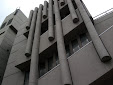
I know not many people do, but I love the 60s brutalist architecture. My favourite buildings on campus - from the Chamberlin, Powell and Bon period - are the Roger Stevens Lecture Theatre and the Worsley Building.

I'm really happy with this picture of Roger Stevens (as we call it, as if it is the man himself rather than a building dedicated to him):


The piping effect on the side reminds me of a church organ. Apparently they do actually contain pipes of some sort (maybe air conditioning) and are not just for aesthetic effect. Maurice Beresford's walks do not seem to cover the precinct area. Maybe he doesn't enjoy the modernist architecture as much as I do.

The Worsley Building is a behemoth. I love it. It is like a massive chunk of impervious concrete. On the campus map it takes up a lot of space and is clearly a giant even from the birds eye perspective of the map. The first time I went inside it I was rather disappointed. I went via the walkways and was not even aware of the point that I entered it. The second time I entered from the dentist school side: when you approach the building there is a moment where you step from the outside and enter its interior. Once inside it is very difficult to get any sense of what the outside of the building is like.


Egypt in Leeds

Another aspect of the university campus that I'm attracted to is what I like to pretend are the secret pyramids.

The first one is at the back of the union building. You can't get to it at the moment because of the building works. I have walked up to it before and looked into the room below. Apparently it was some form of common room but is now unused. I remember seeing old fliers lying around the ledge on the inside of the glass.


The second pyramid actually turned out to be two. From the far side of the Roger Stevens pond you can only see one. The first one hides the second one. They are much smaller than the other one and are made of plastic. Unfortunately, you can't actually see into the space below.


Cavendish Road

Maurice Beresford dedicates a chapter to Cavendish Road. My photo below is of the Presbyterian Church built in 1879.


According to Beresford's text the church was converted to the Clothworker's Centenary Concert Hall in the sixties. I am going to include some of his text about the church here because it is very poetic and quite poignant:

“On a Sunday morning the empty streets allows the ghosts of the unco' guide Celtic exiles to come down the steps unobserved and walk to Hilary Place where pedestrianization has forced their grooms to wait respectfully by the pawing horses, impatient for home and their Sunday lunch of hay in the coach houses of Headingley Hill and Far Headingley.”

This is the topography of yesteryear, and Beresford can see its echoes in 1977 and 1978 when he wrote his text. This reminded me of The Ghosts of Oxford Street by Malcolm McLaren.

The Ghosts of Oxford Street


Conclusion

We forgot to pick up a found object of which we always name the dérive. However, Tim spent some time looking at the campus cherry trees - of which there are many - and picking the ripe cherries. At the beginning of the walk I thought about picking up a cherry stone but decided to wait till later on, then forgot. It wasn't till we were leaving that we realised we hadn't got an object. However, at the gate to my house I found half a blue plastic fork: the detritus of fast food that is the bedrock of student central (aka Headers).

Wednesday, 7 July 2010

What is Schizocartography?


Schizocartography offers a method of cartography that both questions dominant power structures while at the same time enabling subjective voices to appear from underlying postmodern topography. Schizocartography is at once the process and output of a psychogeography of particular spaces that have been co-opted by various capitalist-oriented operations, routines or procedures. It attempts to reveal the aesthetic and ideological contradictions that appear in urban space while simultaneously reclaiming the subjectivity of individuals by enabling new modes of creative expression. Schizocartography challenges anti-production, the homogenizing character of overriding forms that work towards silencing heterogeneous voices.

Thursday, 1 July 2010

A Psychogeographical Guide to Hunstanton Promenade


Guide Psychogeographique De Hunstanton

“Progress is nothing other than breaking through a field where chance holds sway by creating new conditions more favorable to our purposes.” Guy Debord

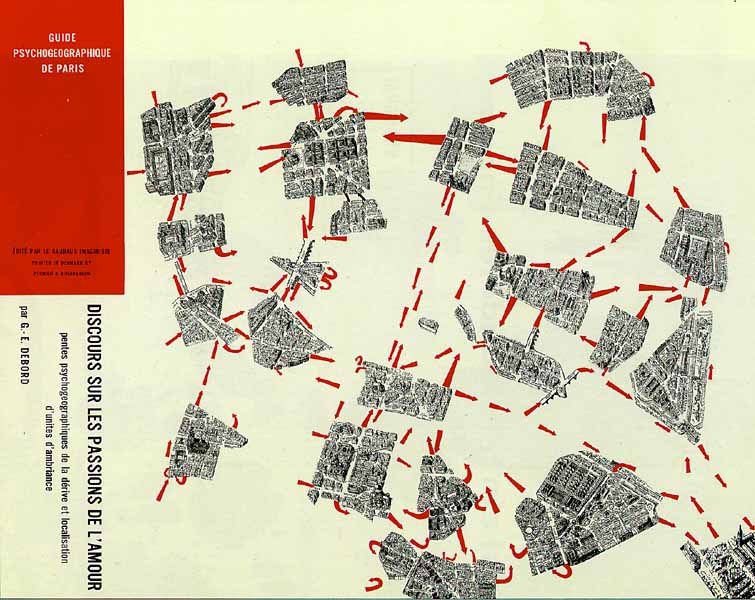
This map is a Situationist-style map based on Guy Debord's 'Guide Psychogeographique De Paris'.

Guide Psychogeographique De Paris

The images highlight various ambiances on the promenade at Hunstanton, Norfolk. The curved line challenges the linear form of the promenade, and suggests an alternative way of walking along the prom (as does starting at the end). The phenomenon represented here do not appear in the order they do in actual space (also, some are transient, some invented e.g. there is no troll). The red of Debord's map has been replaced with blue to reflect the sea. The cream colour, which actually appears in many of the reproduced images of Debord's map, is meant to represent the sand. The text includes: subjective comments, rock music lyrics, popular phrases, a reference to a fairy tale, etc. In this Guide Psychogeographique I have used full colour on the map section, unlike my previous one of the University of Leeds campus, which can be viewed here:

Guide Psychogeographique De University of Leeds

I have noticed an evolution between my first Guide Psychogeographique and the second one and I am interested in seeing how these maps change over time and how far they become removed from the original map of Debord's.

Please note: I would like to give my thanks to those at www.geograph.org.uk who let me use their images. Also, to James Cridland at http://james.cridland.net Much appreciated!

Also, please see my blogs on A Schizocartography of Hunstanton

Bibliography:
Debord, Guy. 1996. 'Theory of the Dérive', Theory of the Dérive and Other Situationist Writings on the City, ed. by Libero Andreotti and Xavier Costa (Barcelona: Museu d'Art Contemporani de Barcelona). pp. 22-27.

Sunday, 27 June 2010

Candle House


Prior to Saturday 26th of June 2010 I had only seen Candle House (the Granary Wharf Building) from the train as it left or entered Leeds railway station. However, after attending the Urban Stories event I was fortunate enough to be able to go inside and view Leeds at 360 degrees from its 21st floor.

Candle House is a solid-looking phallic-shaped set of apartments made from a warm-coloured brick. It has the appearance of being sculpted out of a solid cylinder, rather like those carved candles made from different coloured layers of wax. The staggered effect that appears every few floors gives the building a twisted appearance which adds both a feeling of movement but also prevents too much symmetry from making the building seem dull and lifeless.

Light Shines on Candle House

As well as the 21st floor of Candle House, Urban Stories takes you to the Dark Arches. Joseph Collins regaled us with stories of ancient Leeds clans with punk hairdos; protracted battles between local Victorian Industrialists; and mythological rat people lurking in the network of tunnels off Neville St. The event is a must for anyone interested in local history, the ever-changing Leeds landscape and just great storytelling. Urban Stories is the last Saturday of the month on the same day as the Pannier Market.

For further information on Urban Stories contact Paul at paul.fallon@creativespaceman.com

Joseph Collins Pocket Universes

Monday, 21 June 2010

The Collage Seaside


“Collage is simultaneously innocent and devious.” Colin Rowe and Red Koetter

The above schizocartographic image was made by cutting photos of Hunstanton from various brochures and leaflets that advertise the seaside town. The pasted words and phrases are mostly popular terms that refer to seaside resorts, but were actually taken from the adverts of businesses or organisations located in the area. The other terms refer to the analysis and theory of urban space and have been added digitally. The quotes are comments on urban space by the following:

1 - Iain Sinclair
2 - Brian Jarvis
3 - Felix Guattari
4 - David Harvey
5 - Henri Lefebvre

This 'map' has been named after the book Collage City by Colin Rowe and Fred Koetter. It has been created for the following project 'Reading the Arcades/Reading the Promenades'.
Please see my blogs on A Schizocartography of Hunstanton located here:
Part 1
Part 2

Bibliography:
Row, Colin and Fred Koetter. 1987. Collage City (Cambridge, Massachusetts: The MIT Press).

Tuesday, 8 June 2010

Kirkstall Valley Subdub or The Prozac Walk

Sunday May 20th 2010. I set off from home with the intention of checking out the Kirkstall electricity sub-station (Leeds), which I had first stumbled upon in the summer of 2008.

National Grid Sub-stations

Redcote Lane
The entrance to Redcote Lane is from Kirkstall Road. It is a strange space (part hinterland, part heterotopia) with a number of leisure pursuits represented. These are juxtaposed with the preservation area that runs by the river and this large sub-station which dominates the end of Redcote Lane. As you enter Redcote Lane you can hear the cracking-crunching sound emanating from the recycling centre on the right. You then walk over a really interesting green iron(?) bridge that crosses the river Aire:


Past the bridge is a 'Fitness First' leisure centre and opposite is a small fenced-off part of the electricity sub-station. This is probably what the deep topographer Nick Papadimitriou would call an “adjunct” to the bigger system at the end of the lane. The golf course crosses the lane (between the first and second tees) and to the left there is a 'Goals' five-a-side football centre with the tagline “The Beautiful Game”. Most of the traffic in the lane (barely any, though) is for the leisure outlets.

Kirkstall Valley Nature Reserve
The gate at the entrance to the reserve on the right of the lane is designed by the children from Burley St Matthias School:


This gate takes you onto a path which stretches along the banks of the Aire and the Leeds and Liverpool Canal. I think it is possible the preservation area stretches as far as Kirkstall Abbey, but I have only walked part of it in the past, although from a window of an office on Kirkstall Road I have seen some interesting wildlife, including kingfishers. I spent the summer of 2008 working at this office in between my BA and MA. I used to gaze longingly into the river on hot days, thinking about arranging some kind of performative act which involved me donning a swimsuit and flinging myself into the Aire.

The Bridges
Right near the entrance to the nature reserve are two bridges. The first is a modern bridge used by the railway, bridge no. TJC3/22 (I am including the bridge references for the benefit of any train-spotters who like to search for this kind of information). Directly after that bridge, with barely any space in between, is the old, probably Victorian, bridge (TJC3/22A). A google search for these bridges throws up a Yorkshire Post article about water leaking from the base of the modern bridge, apparently threatening to flood the sub-station and 'Goals'. I really like the two bridges next to each other (the modern and postmodern). The Victorian bridge is particularly attractive and my photo does not do it justice:


The Electricity Sub-Station
As you pass under the bridges the sub-station is straight ahead. My second visit to it was not as aesthetically powerful as my first. I think this was because it was a surprise discovery the first time around. Nevertheless, I don't want to understate how imposing it is. Its dominance is of a monolithic nature.


The sub-station is surrounded by greenery and it sits in a kind of enclave amidst the trees, grass and foliage. So, you have the sound of birds and the wind blowing through the trees, and also the hum of the station. Different parts of the site emitted different sounds. At one point there was a clicking sound coming from the machinery, which sounded rather like a cricket.


Signs and Notices
I took a few photos of some of the signs but as I got to the point of taking a photo of an interesting looking National Grid sign which was falling apart, I got the visit-from-security. I had noticed the portakabin and knew there was someone in there but thought I could sneak past to the gate and get the shot. But, no chance. Mr. Jobsworth, bored to death in his cabin, was going to allow me to 'make his day'.


One of the signs had C E Electric UK written on it. Who, according to their website, are “...responsible for delivering electricity to over 3.8 million properties across the North East of England, Yorkshire and northern Lincolnshire.”:

C E Electric UK

On the same sign was another logo: SmartWater, which appears to be a police sponsored crime reduction initiative. I did see a police van drive around the area while I was there. Interestingly, they didn't see me as a 'threat', even though the security guard obviously did. What is SmartWater, you may ask? Well, their website explains that “...SmartWater is a colourless liquid solution that is simply dabbed onto the uneven surfaces of your valuables. It can be used to code all sorts of items such as jewellery, ornaments, electrical items and even your motor vehicle. Each bottle contains a unique chemical ‘code’ which is registered to you – conclusively proving ownership. It cannot be easily seen by the naked eye and is almost impossible to remove. The liquid glows under ultraviolet light making it easy for the Police to detect.”.

SmartWater

Concluding the Walk
After being caught by the security guard, I walked in the direction of the exit and I think the guard thought I had left. But, I actually continued to walk around the sub-sation and take more photos. I found a caravan storage park and also, at the back of the sub-station I found a place that moored boats:


I then sat down on the grass to write up some notes. But after about 5 minutes I could see the security guard walking towards me and I made a quick getaway. When I was walking back home up the hill towards Burley the sky ahead of me looked dark and ominous, whereas behind, over the valley, the sky was bright, sunny and dotted with white clouds. The two photos below are from the same spot on Argie Road: the first towards Headingley and the second towards Kirkstall Valley.


When I entered St Michaels Lane in Headingley I spotted a green and yellow pill on the pavement. I decided to name the walk after the pill, which turned out to be fluoxetine, aka Prozac.