Thursday, 13 June 2013

Apocalypse Now: The Vietnam War on Perception


This blog is the third and last in a series of film studies blogs that I wrote during my own Cultural Studies BA at the University of Leeds. I have loaded them here as a teaching aid. Please click on the links below for the other two blogs:
Framing the Russian Ark
Clockwork Orange

Abstract:
This essay looks at how Vietnam is portrayed in popular culture by using the example of Francis Ford Coppola's Apocalypse Now (1979). The Vietnam war was described as ‘the first television war’ and ‘the first postmodern war’ and while modern technology made readily available images of war for those at home, over time subsequent imagery from the multiple films made about the war have become conflated with war footage. This essay provides an example of mediated representations of history through the examination of the scenery, characters, politics and production of the film.

Extract:
Apocalypse Now is known for its surrealist format: “it is a dream, a baroque dream of napalm and of the tropics, a psychotropic dream” (Baudrillard 1994, p.59). The film begins with the haunting sound of The Doors song The End (appendix 3, p.10) which echoes the reflexive element of the film. In a way Willard has already taken the journey, he took it in his hotel room in the opening scene. It is not necessary for him to actually go down the river: the journey is symbolic. In the same way the war itself was not 'necessary' and was carried out for a whole host of reasons other than the ones presented to the public. The beginning of the film is the end of the film because, as Baudrillard explains, the film and the war are actually about “the reversibility of both destruction and production” (1994, p.60).

Click here for a full downloadable pdf of the essay:
The Vietnam War on Perception

Friday, 7 June 2013

Once Upon a Time: A Lacanian Analysis of Clockwork Orange


This blog is the second in a series of film studies blogs that I wrote during my own Cultural Studies BA at the University of Leeds. I have loaded them here as a teaching aid.

Please click here to see the other blogs:
Framing the Russian Ark
Apocalypse Now: The Vietnam War on Perception

Abstract:
This essay offers a Lacanian analysis of Stanley Kubrick's adaptation of Anthony Burgess' Clockwork Orange. Using Jacques Lacan's theory on the symbolic order - in particular his themes of lack, the unconscious, the phallus, the signifier/signified and speech - I use a scene in the film to explicate his theory of sexual difference. The essay is written as a story which utilises the style of a fairy tale in order to draw attention to the different voices in the film, to allude to the original myth of Oedipus and to make reference to the forgotten episode of our own enculturation via the Oedipal trajectory.

Extract:
Alex knows the cat lady doesn’t have the phallus. Women just feature in his life as objects to be done to. But, Alex is under the misapprehension that he does have the phallus. He doesn’t realise that no-one has the phallus. He believes the phallus represents potency, it signifies the life-force. He thinks he is one with his penis, and that the penis-sculpture he holds to his groin is this unity writ large. He actually believes he is the phallus. However, he does not realise that he is not seamless with the phallus: not only does the phallus exist in a space he cannot gain entry to, but his body is a fragmented one, he is a divided self, due to his prior misidentification at the mirror stage.

Click here for a full downloadable pdf of the essay: Once Upon a Time

Saturday, 1 June 2013

Framing the Russian Ark


This blog, and the following two blogs, provide good examples of undergraduate cultural theory/film studies essays. I wrote them during my own Cultural Studies BA at the University of Leeds. All three essays received a first. Reading them retrospectively, while I can find fault in them from the position of someone who now marks undergraduate essays, I do still think they have merit. They stand as creative and well-researched essays on the films they are discussing and I have loaded them here as a teaching aid.

Abstract:
This essay provides a deconstruction of Alexander Sokurov's film Russian Ark using Jacques Derrida's Truth in Painting as a vehicle for exploring the use of framing within the film. Using Derrida's theory of the parergon I demonstrate how the director uses the viewing subject as a tool within the film itself and explain the effects of this on the spectator and what the result of this might be for Sokurov.

Extract:
The camera follows the Marquis’ stroll around the gallery, which also involves a discussion with two visitors who are actors playing themselves: Sokurov’s real life friends Lev Yeliseyev and Oleg Khmelnisky. But, rather than keeping the camera still and centring the three characters in the middle of the frame, the camera very slowly moves up and down, to the left and right, rolling slightly and incorporating the paintings in the background (appendix 3, p.10). At one point the camera zooms slowly into the painting The Birth of St. John the Baptist (Jacopo Tintoretto c1550) which has the same three characters standing in the foreground. The shot incorporates the frame of the painting, with the characters closely examining the detail of the image just above the lower part of the frame, pointing closely at particular elements. Is this the exercising of the parergon in that this action by the characters is a bridge over the abyss described by Derrida in the closing of ‘Lemmata’ (1987, p.36) and on the cusp of his opening into ‘The Parergon’?

Click here for a full downloadable pdf of the essay: Framing the Russian Ark

Here are the other blogs in this series:
Lacanian analysis of Clockwork Orange: Once Upon a Time
A political critique of Apocalypse Now: The Vietnam War on Perception

Sunday, 26 May 2013

Clayton Wood Arising

Last weekend I went for a walk to explore the Clayton Wood Rise Industrial Estate in Horsforth, Leeds. It's directly south of Clayton Wood and is in stark contrast to the wooded area which abuts it. You can climb over one of the low barriers around one of the business outlets there, and actually get into the wood at the back of the industrial park.


The above photo was shot from the edge of the wood overlooking the industrial park. The photo montage below is a dialectic of images of the wood set against those taken in the industrial estate..


Links to other Horsforth Walks:
The Lickless Dérive
The Morphology of Trinity

Tuesday, 21 May 2013

Writing: exposing the self in the between of living

(an undergraduate’s perspective on essay writing)


I found this piece of text today when I was looking through my old undergraduate files. I had forgotten I had written it. It's not too shabby so I thought I'd post it here:

I write all my essays as if they are my first: embarking on an adventure which, although subject to planning, is likely to take me to unexpected places. Do I march boldly into the terrain or just take a few tentative steps? Either way I am exposed. I push forward. I am prepared: ready to learn about the subject and myself. Entering the geography, the territory opens up and receives me.

This is a ritual. The screen has become a wormhole. I bow to it: Namaste! I bow to that in you which is also that in me.

The screen is a portal that can take me anywhere in the universe, traverse time and space. I am anticipatory, my cognisance heightened. Where shall I go?

I search for that place which sits between deference and arrogance: a subtle space which must be negotiated. Can I find it? There is a sliding of surfaces. My feet are unsteady. I feel unstable on this ground. Ego is visible, egotism is ‘writ large’. My writing needs to be confident, not feeble, not conceited. I am trying too hard. In my anxiety to find that space, it slips away. I relax…There it is! Delving into the depths of the landscape she takes me into herself…

I only exist in my becoming. I am rewriting myself, anticipating the self I am yet to be. I stand in the moment where I simultaneously await and become that which was awaited. I reach out to grab the intangible self and it eludes me. The 'I' in the writing becomes the past 'I'. This transient 'I' appears in the space of the writing, in the event. Time is collapsed. I exist in the moment of writing, in the future-anterior of the other’s reading of me…

It is the conclusion. I am in conclusion. Where is the sentence that bites? Where is the hook that will pull you in and leave you gasping on the deck? I want to offer you more: not an ‘answer’, but something that tugs at you and twists inside you.

I write all my essays as if they are my last: you are, after all, only as good as your last novel/hit single/assignment. The deadline is here. Laid bare on the page I submit myself. Doubly exposed.

My essay is not being read, I am being read. And, not just the small 'self' of the everyday, but the 'I' of the interstice, the Self of Brahman that peeps through the words I write…

Tina Richardson

This piece of prose is inspired by the work of Helene Cixous.

Sunday, 19 May 2013

Organ Pipe-clad Concrete and Lost Students

Chamberlin Powell and Bon in Leeds


For Part 1 of this blog, please click here: Chamberlin, Powell and Bon in London

Thanks to those of you who met me at the Barbican in my last blog. We are now in West Yorkshire at the University of Leeds, taking a look at the work that Chamberlin, Powell and Bon (CPB) undertook on the campus in the 60s, as Master Planners for the big post-war campus project. The challenge for the university and CPB at this time was manifold and included such problems as creating a holistic and cohesive campus, offering a look and feel that would signify the vision of a new university, and to do this within the scope and limitations set by both the university and the city itself. The two plans they produced at the early stages of the project are not only fascinating to read, but works of art in their own right (see below).


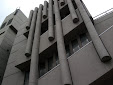
The photos shown in this blog are of the Roger Stevens Lecture Theatre (colloquially known simply as 'Roger Stevens'). People's views on the aesthetics of the building (students and academics alike) are polarised. However, I think many feel that way about Brutalist architecture generally. The organ-pipe clad concrete-formed Roger Stevens is a prime example of Modernist sixties architecture at its best. Recognised as a Grade II listed building in 2010, its existence has since become justified, following the period in the 70s and 80s when people began to lose faith in the Modernist project, and councils started to pull down their public housing projects (see information and photos on the Pruitt-Igoe, or watch Godfrey Reggio and Philip Glass's superb film Koyaanisqatsi to see its demise).


The original design for the Roger Stevens was very different from the final lecture theatre, as can be seen in the architecture's mock-up below:


The final Roger Stevens is woven into the campus via raised walkway access (as above) which seamlessly takes you from the higher ground further up the hill, directly into the building. However, once inside things begin to get complicated. Most people find it hard to negotiate because of multiple staircases and what seems like an unintuitive layout. I have been at the university since 2005 and always have a problem finding the actual lecture theatre I am looking for.

One of the more intriguing and lesser known facts about the Roger Stevens, though, is that a broadcasting studio was built in the basement. I didn't know about it till 2012 when an exhibition was held there: Celine Condorelli's 'Additionals'. I went to the private viewing and include some of the photos I took of the event below:


In the last blog I mentioned how little information there was on CPB, especially by themselves, however I did come across an article by Chamberlin in The University of Leeds Review (May 1969) entitled 'The Evolution and Realization of the University Development Plan' and include a quote from that article here:
A university should have a sense of wholeness which is not fostered by segregated planning. [...] An early task in evolving a Development Plan was to establish valid principles of design calculated to meet the ascertainable need of the University and to invent a vocabulary of design which could be relied on to meet a whole variety of situations and problems.
In the conclusion of Elain Harwood's chapter on the University of Leeds in the RIBA commissioned book, Chamberlin, Powell and Bon, she says of their work at Leeds:
That the Leeds plan as originally envisaged by Chamberlin, Powell and Bon was never fully realised became inevitable following the imposition of financial restraints. Building struggled on through the 1970s, although after 1973 funding was cut by 90 per cent. Powell recalled that 'the government eventually discovered that it had briefly over-expanded higher education.' Money ran out, and a new generation moved in who wanted change.
You can watch a film I made based on my own response to the sixties precinct area of the university campus, including the area around the Roger Stevens. Here is part of the abstract for the film by way of explanation. The link to the film is below it: "This 3 minute film is an acoustic psychogeographical response to the area called the precinct and features two of the most impressive buildings of this era."

Film: The Sound of the Sixties: Chamberlin, Powell and Bon

Links:
Chamberlin, Powell and Bon: Space Age or Quasi-Totalitarianism?
Chamberlin, Powell and Bon: Does the old campus make sense in the present?
Chamberlin, Powell and Bon: The Return of the Repressed

Thursday, 9 May 2013

Brutalist Access Points and Disappeared Stationers

Chamberlin, Powell and Bon in London


It was interesting to revisit the Barbican (built 1965-1976) in London recently with the, now, knowledge of the Le Corbusier inspired architects Chamberlin, Powell and Bon and their brutalist design. When I worked in this area of London in the late 1980s I spent quite a bit of time in the Barbican, in fact I was based on the edge of it in one of the offices in Aldersgate Street. The company I worked for then was Jockelson Stationery (below is a photo of the office today - they have long gone). Little did I know that a few decades later I would be studying the architects as part of my PhD research!


Chamberlin, Powell and Bon (CPB) are not known for saying a lot - there isn't much written by them, or about them. But, thankfully, in 2011 a book was published by RIBA written by Elain Harwood, in the 20th Century Architects series, called Chamberlin, Powell and Bon. However, I like to think that their architecture did the speaking on their behalf, as these photos that I took of the Barbican will show:


Harwood says the "Barbican suffers from its compact site and a difficulty of access for the uninitiated, with its lack of easily identifiable access points". (2011: 129) And, this is definitely true of my own trip, despite the fact that I knew the area from the past. I had forgotten this ramp (shown above and below) on the Chiswell Street side and initially headed across the road towards some stairs I could see, which didn't actually take me up to the surface on top of the underpass, where the allude to take you.


While I quite like the mystery of 'un-identifiable access points' - I am a psychogeographer after all - this is not an uncommon criticism of the work of CPB, as students at the University of Leeds will testify to when attempting to find their way around the Roger Stevens Lecture Theatre (more about this is in part two of the blog). Nevertheless, I don't think this detracts from the overall work and, having read their plans for the University of Leeds, many of the decisions which resulted in these oddly hidden entrances are based upon saving space, streamlining, or other such economic decision-making processes.

Harwood says of the Barbican: "it was resoundingly the Barbican that Chamberlin, Powell and Bon's depth and range of vision in planning, design and detailing were consumately realised. It brings together the sense of scale and imagination that charges all their work, on an exceptional canvas." (2011: 130) However, the Golden Lane Estate (completed 1962) nearby should not be forgotten. It still looks good after all these years, especially when you consider how many of its peers have now been demolished. But what is that interesting-looking lip on the top of this iconic building?


Part two of this blog looks at CPB in Leeds: Organ Pipe-clad Concrete and Lost Students