Showing posts with label Los Angeles. Show all posts

Tuesday, 26 March 2013

Deconstructing the Ziff - Part 1


Up, Down and Around or The Chamber of 32 Doors

"There were doors all 'round the hall, but they were all locked; and when Alice had been all the way down one side and up the other, trying every door, she walked sadly down the middle, wondering how she was ever to get out again." (Lewis Carroll Alice in Wonderland)

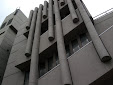
On the University of Leeds campus we often find new buildings 'shoe-horned' into small 'leftover' spaces, much like the Marjorie and Arnold Ziff building which was opened for business in January 2009 and operates as an administration centre, primarily for students. The building appears squeezed in between the end of a Victorian terrace and one of the lecture blocks, the Michael Sadler Building.

This recent building has the effect of drawing attention to the buildings either side of it if you make an effort to look, but despite these architectural differences urban space operates such that it naturalises the very space that it forms, hiding those differences. Postmodern space is hugely complex because of the history on which it sits; yet there is a type of homogeneity also operating which smooths that space and presents it to the viewer like it has been that way 'forever'.

This is one of postmodernism's paradoxes well noted by Fredriç Jameson. He explains how the notion of a dialectic opposition is not something that appears in the analysis of postmodern society in the same way that it did in a more modernist or Marxist period. (2009: 344) He goes on to say that the cultural objects considered under postmodernism often seem to "fold back into each other". (ibid.) This is apparent when viewing postmodern space, especially in the examples Jameson offers, such as the Westin Bonaventure building consisting of four mirrored columns which simply reflect Los Angeles back to itself.


While it would not be possible to describe the Marjorie and Arnold Ziff building with the same intensity that Jameson describes the Westin Bonaventure - it is not exactly a postmodern hyperspace - it does share some of its qualities, to varying degrees. There are two entrances to the Ziff building. The main one is obvious and is the one that you would first come to if you were encountering the campus from the main university entrance. Here you are taken in to the queueing area that students who require administrative assistance would use. There is also a staircase straight ahead that takes you up to the café on the floor above, which once you are a few feet into the foyer, you can see opening up at the top of the stairs and overlooking the administration area. However, from the other end of the building there is a much smaller, less obvious entrance which takes you on to a level which is between these two floors, requiring you go down a few steps to enter the student admin area, and up a few steps to enter the café. This is slightly disorienting if you have previously only ever entered the main entrance before, as you are not necessarily aware of the slight incline on which the building is built, even if you regularly walk that slight uphill path on your way elsewhere. The image below shows almost the full length of the building on that side, which is not a great distance. However, it is enough to mean this smaller entrance cannot take you directly onto the ground floor of the building inside.


Once just inside this other entrance, while you can work out where the administration area is in space (it is still visible from outside these windows you see in the image above), the café has suddenly disappeared from view. It is closed in at this end of the building and it requires a moment for you to realise that you are entering the building on a different level, and that since there is only one staircase that goes up, it must be that direction you need to take. This disoriented moment is fleeting, but nevertheless is a common side-effect of postmodern buildings, an example of which was recently expressed to me by a friend attempting to orient herself in the newly opened shopping centre Trinity Leeds, which truly is a postmodern hyperspace.


Part 2 of this blog will look further at the mirroring effect of the glass surface of the Ziff building.

Bibliography: Jameson, Fredriç. 2009. Postmodernism or The Cultural Logic of Late Capitalism (London and New York: Verso).

Wednesday, 15 December 2010

At UCLA You See LA


I went to the University of California, Los Angeles on the weekend of December 4th and 5th to the Spaces and Flows conference Being a psychogeographer, I was very excited to be able to walk in a totally new kind of urban space. This was my first visit to an American University and to the US. This is my blog on UCLA:


Mapping UCLA

Just having logged into the university site, I find that a high level article is discussing how recent research is using GIS to map geographic areas where fastfood is located, and comparing this to public health.

Putting Public Health Concerns on the Map

I also found this great map in the Daily Bruin (the UCLA newspaper), while I was there. It comes under the heading Crimewatch and maps the crime in a one week period on campus. These are my favourite crimes:


"On Nov. 27, a man yelling at security officers was escorted from the Doris Stein Eye Research Center."

I'm not exactly sure why I like this one, and why it makes me laugh. I think it's the specificity of the place name and the possibility that the chap may simply have been poked in the eye by a researcher.

"On Nov. 22, marijuana was confiscated from behind Canyon Point."

Well it is a university campus after all. What more can I say. If there wasn't any marijuana (or, by the way, illegal alcohol - it is a dry campus), I would be concerned.


University Architecture

The campus at UCLA is pristine, elegant and I would even say beautiful. Most of the buildings are of the style in my above photo, and like the ones below:


However, the campus does not seem to have a lot of 'character' probably because the architecture is not diverse enough to enable that. There were some modernist buildings as well, but most buildings were similar to the style of the ones above, built with the pale salmony-pink brick. It tended to give the campus a homogeneous look - which I guess some will find attractive and some not.


Urban Décor

This section of my blog looks at the usual psychogeographic urban phenomena that I tend to observe, and I will include a series of photos with short comments.

The university staff (maintenance, etc) seemed to have access to these buggies to enable them to move effectively around the space. I even saw a student with a suitcase on the back of one at one point:


These lovely little signs appeared on the pavement outside the sports stadium. I assume they guide the supporters to their terraces. The university mascot is a bear (Bruin the Bear, actually its called Joe). However, I would like to challenge that and propose that the lovely mango-tummied squirrels replace the bear. The Fox Squirrels are all over the campus. See my future blog for more images on the UCLA squirrels.


These signs were outside the Ackerman Union. They even remained overnight. Although they were located only in one specific area, I got the feeling that they would not be allowed on the University of Leeds campus, unless it was for a specific one-off event.


I was handed this document outside the union.


The following three images are of various types of pipes, although I don't know what the first one is. The last two were on the periphery of the campus. I really like the blue and red pipes next to each other.


I also found this 'No Dumping' notice on one of the roads surrounding the campus. I like these signs that are made of concrete and situated on roads and pavements. They are less dominating and aggressive than vertical signs. I've never seen any like this in the UK.


This is the UCLA Guest House, where I was staying, and below that is an interesting church that was very near the campus.


Aesthetic Observations

What I found particularly interesting is that on one level at least, UCLA reflects the way that LA operates spatially. There does not seem to be a centre to the UCLA campus. There was not even a central administration building that I could find where I could get information about the campus. I asked people but no-one seemed to know. Also, there is no main entrance, like for instance, there is at the University of Leeds (the Parkinson Building and its famous steps). There was only a number of insignificant entrances which were oriented around LA's favourite object: the car. Here is one:


The entrances were not designed for the person entering on foot, as they all lead to car parks. Nor were they designed as symbols of the university that may represent a brand, as indeed the Parkinson Tower does for the University of Leeds: University Tower

Note the tiny tower symbol on the logo:
University of Leeds

UCLA, like many campus universities is a mini city. But it is not a mini city in the conventional sense, it is much more like the Westin Bonaventure in its postmodern disorientation. The university buildings and those in the surrounding area, bleed into each other and do not appear clearly on relative sides of the distinctive boundaries like they do on the map provided online: UCLA campus map

I have walked around the periphery of the University of Leeds campus, and there is a much more clearly delineated line where the campus ends and begins: The Forgotten Solo Dérive


Letters from UCLA

I wanted to sign-off with a really juicy and appropriate quote from someone like Baudrillard, or maybe find an entertaining youtube video about campus life. Most of what I found on youtube were really gushy films that I just couldn't subject anyone to; some were university marketing department created ones. Anyway, I don't even think this one is ironic. I thought it was at first, but then, reading the responses, I doubt it. But it is worth looking at as it is the most creative and interesting of the ones I found:

UCLA University of California, Los Angeles, Westwood

This is Tina Richardson, situated in a studio flat in Headingley, signing-off...

Relates websites:
Wikipedia on UCLA
UCLA Bruins

Thursday, 9 December 2010

An Englishwoman in LA

I'm just back from a conference in LA (at UCLA) called Spaces and Flows where I gave a paper on schizocartography. I managed to get over there a couple of days before the conference in order to check out LA and do some urban walking. The following blogs will be covering a psychogeography of LA and will be appearing here on particulations over the next couple of weeks:

1 - An Englishwoman in LA (this blog)
2 - The Good Adventure: A Psychogeography of the Westin Bonaventure
3 - At UCLA You See LA (urban walking on UCLA campus)


You Can Check Out Any Time You Like But You Can Never Leave

These photos are views from my hotel in Downtown LA (Little Tokyo). The first one is from my hotel window (early morning), the second one is at street level.


The Hotel Miyako was really well situated for 'cultural' Downtown LA. I could walk to a number of galleries and museums and, more especially, the Westin Bonaventure which I really wanted to see thanks to Frederic Jameson:

Postmodernism, or the Cultural Logic of Late Capitalism


Walk/Don't Walk

I was slightly disappointed not to see the Walk/Don't Walk signs that I associate with the States. Maybe they only exists in some states, or maybe they are a thing of the past:

Walk/Don't Walk

Instead they had a red hand and a white walking man. The red hand counts down after a while to tell you how many seconds you have left to cross. It took me a few crossings to work out what the protocol was - and the roads are big, so you don't want to get stuck halfway. It seems that even when the white walking man appears, that cars can turn into the road providing you are not on the crossing. I must admit, I was confused and slightly anxious when crossing at first, as it was early in the day and not many pedestrians were around to mimic. But eventually I worked it out by seeing what others did, and reading the instructions on the side of the road. By the end of my trip I was getting quite cocky and even running across when the red hand was counting down.

Stop/Go


Urban Décor

Here is a sample of some of the urban décor that I came across.


I think I may start taking pictures of fire hydrants from around the world - we don't have them in the UK, or rather they are under man-hole covers. I got a nice image of a red one in Marrakesh when I was there in September. I took the above one in LA. They appear on the corner of every street.

Here is a heavily graffiti-ed rubbish bin (dumpster?). It's not artistic at all, but I was interested in the layers of graffiti that have appeared over time.


I had to take a photo of the signage for the bail bond agent as we don't have them in the UK. I went into the office to ask if I could take the photo. The manager was fine and appreciated that, being from the UK, they are of interest to foreigners.


This is how wikipedia describes Bail Bondsmen:
"A bail bond agent, or bondsman, is any person or corporation which will act as a surety and pledge money or property as bail for the appearance of a criminal defendant in court. Although banks, insurance companies and other similar institutions are usually the sureties on other types of contracts (for example, to bond a contractor who is under a contractual obligation to pay for the completion of a construction project) such entities are reluctant to put their depositors' or policyholders' funds at the kind of risk involved in posting a bail bond. Bail bond agents, on the other hand, are usually in the business to cater to criminal defendants, often securing their customers' release in just a few hours."


The above two images were taken quite close to each other in the region of Los Angeles St and Temple Street. I can't remember the exact location. I went into the mall. When I first spotted it on the map I was hoping for a really grand American mall like the ones you see in films. Sadly, it was more like an Arndale Centre (see my previous post on Headingley Arndale Centre: The Headingley Arndale Centre: Today and yesterday). Actually, it wasn't even really like an Arndale Centre, that would have been a compliment. It was one of those like the ones we get in the UK on the edge of towns. They are scruffy and concrete and look like they emerged in the 1970s. There's one in Norwich called Anglia Square which the Los Angeles Mall reminded me of: Anglia Square.

I liked the public art that looked like a space ship. It was massive and was really colourful in the sun. I don't have the name so can't look up any information on it. It looks like it might be Central American influenced. There were many homeless people in the area around the sculpture, on the surrounding benches. I saw lots of homeless people in Downtown LA and didn't even get as far as Skid Row. However, they do seem to have more 'stuff' than the UK homeless, which they moved around in shopping trolleys or by other means, sometimes piled over six feet high.


The Museum of Contemporary Art

MOCA is well worth a visit if you are in the area. There are works from Jasper Johns, Claes Oldenburg and Jackson Pollock in the permanent collection. The following images are from outside the gallery:


El Pueblo Historic Park

One afternoon I went to El Pueblo Historic Park which was about a 15 minute walk from my hotel. These are the images I took in that area. The mural photo came out really well. The park itself was a strange place, really rather like a non-place. It was quite fragmented. I couldn't work out who it was designed for. The Christmas tree looked strange to someone from the freezing north of the UK: seeing it in the sun surrounded by palm trees was very disorientating.


Be Yourself No Matter What They Say

I could have easily spent a week in Downtown LA, walking around the district. While I have not done a typical psychogeographic blog of the area (i.e. ignoring the obvious and taking photos of mostly signs and other urban phenomena), I hope that I have provided a somewhat alternative view to the conventional tourist approach. There were plenty of interesting buildings that I thought about photographing, for instance the Walt Disney Concert Hall, home of the Los Angeles Philharmonic Orchestra. Also, I didn't want to do a conventional psychogeographical urban walk and ignore objects that interested me. So, I guess, this blog is somewhere in between the two: neither anarchic, nor customary. I suppose it does reflect the title: An Englishwoman in LA. Perhaps this is my Crispesque subaltern response to Los Angeles. Because of this, and also because I may have short-changed those hardcore psychogeographers out there, I will close this blog by including the lyrics from the Stranglers song Dead Los Angeles. That way, no one can accuse me of totally selling out ; )

The Plastic Peaches There
On Concrete Beaches There
You See The Leeches There
They're Soft Marshmallow There
It's Oh So Shallow There
In Dead Los Angeles
In Dead Los Angeles
The Dredged Up Mastodon
Has Got His Glasses On
He's Never Seen The Shit
From The La Brea Pit

The Lunar Base Camp There
With Burning Midnight Lamp
They Call It Frisbeeland
It's Just A Disneyland
Android Americans
Live In The Ruins There
In Dead Los Angeles
In Dead Los Angeles
The Dredged Up Mastodon
Has Got His Glasses On
He's Never Seen The Shit
From The La Brea Pit (repeat x 6)

They Get The Tremors There
Been Give Babylon
Plenty Of Companies
Such Lonely Company
I Hear A Symphony
Of Lonely Tympanis
In Dead Los Angeles
In Dead Los Angeles
The Dredged Up Mastodon
Has Got His Glasses On
He's Never Seen The Shit
From The La Brea Pit


Relates websites:
The Stranglers, The Raven Album
Spaces and Flows
An Englishman in New York by Sting
Museum of Contemporary Art (MOCA)