Showing posts with label perambulatory sutures. Show all posts

Tuesday, 19 May 2015

What are Perambulatory Hinges?


Following on from my mention of ‘perambulatory hinges’ at the World Congress of Perambulatory Sutures last week, I feel the need to qualify the term in order for it to be pinned down as much as possible. If any of my psychogeography students want to use the term, I would hate for them to use it incorrectly and lose marks in their assignments because of that. So, here are the guidelines for establishing (or writing about) a perambulatory hinge:

1 - A perambulatory hinge is not a ley line!

Ley lines are attributed to Alfred Watkins and he refers to them in a number of his books, for example The Old Straight Track (1925). While you can obviously read the Wikipedia page on ley lines, some psychogeographers think that Wikipedia is not clear enough about what a ley line is. This is how Jeff Belanger opens his blog about his own investigation into them:
A study of leys taught me that the current general idea of what ley lines are is pretty off base. But in researching the phenomenon, some truly intriguing earth energy mysteries can be found. There are fairy paths, corpse roads, geister wegen, and a slew of other supernatural linear features on our planet where people do come for spiritual experiences, and there are "roads" that ghosts have been reported traveling down repeatedly.
Check out Belanger’s helpful article for more info: Ley Lines, Old Straight Tracks, and Earth Energies

2 – Perambulator hinges are subjective, but come into being collectively!

Perambulatory hinges are generally attributed to postmodern space. Or should I say, they are predominantly a postmodern event/occurrence (this will become apparent when you read the theory part explained in no.3 below). They work through a kind of ‘calling’ made by a particular piece of urban phenomenon. Because the calling is psychogeographical – i.e. a particular person is responding aesthetically/affectively to the object – it is subjective (therefore individual) in that aspect. However, as well has having our own personal responses to urban objects, we very often share our reaction with others (although not exclusively, as it is also cultural). So, when a particular object ‘calls’ to a number of people in a similar way over time, a perambulatory hinge develops. This is how it works…

3 – Perambulatory hinges can be best explained through the concept of ‘subjecting’.

In an Althusserian sense the object actually subjects you. It recruits you through its effects. It may not recruit you in the absolutely ideological way expressed by Louis Althusser, but nevertheless it is a cultural effect, so in that sense it may still be ideological. So, like the policeman in Althussers example in ‘Ideology and Ideological State Apparatuses’, the urban décor hails you – well it hails anyone, but you feel it is hailing you, specifically – and you, sort of, do this 180 degree turn that Althusser says occurs at the point of subjection. Consequently, you recognise the calling of the phenomenon in its personalised hailing of you. The object, in its expression which is directed at you, appears in its obviousness: it really is calling you. Althusser explains that this is how ideology is “endowed with a material existence”. The effects of the response to the calling retroactively produces its cause through subjecting the individual. Therefore, the individual responding to the urban phenomenon, as subject, is both the cause and effect. This is the effect of the urban apparatus of which the individual is subjected, but it is also what produces her/him as the psychogeographer in that moment, as the cause of the effects.

4 – You cannot see a perambulatory hinge.

When this calling and psychogeographical response is similar among the ‘community’ in regards to a specific piece of urban décor - and when it occurs multiple times over a period of time – eventually a perambulatory hinge arises. You cannot see the hinge come into being, you can only surmise that it might be there. Of course, you could verify it through discussion with the psychogeographic community. The hinge appears when it reaches a kind of critical mass. Even though it is invisible it nevertheless is still material because it is caused by this ‘180 degree turn’ mooted by Althusser (of course, it isn’t really necessarily exactly 180 degrees, though - this is metaphoric). While you cannot exactly pinpoint the exact position of the hinge in space, you can probably work out roughly where it may be by looking at lines of sight, etc. However, unlike a desire line – which is very apparent – it is not visible, although sometimes there may be traces...

Please click here for another post on Birmingham. I will be further fleshing out the concept of perambulatory hinges in a future article.

Saturday, 16 May 2015

The World Congress of Perambulatory Sutures


The World Congress of Perambulatory Sutures took place in the North of England this last week, culminating in two extraordinary events, one held in Huddersfield and one in Leeds. I use the word ‘extraordinary’ here in the definition of both ‘unusual or remarkable’ and also ‘specially convened’. These events were ‘Class Wargames’ at the University of Huddersfield (13th May 2015) and ‘The Inside Out of Walking Inside Out’ at the University of Leeds (14th May 2015). Psychogeographers travelled through time and space for these events. From as geographically far away as Paris, as temporally distant as the London Psychogeographical Association of the 1990s and as virtually far away as the online Outbounding forum, The Art of Exploring.


Class Wargames
University of Huddersfield 13 May 2015

Dr Alexander John Bridger arranged for Fabian Tompsett, Richard Essex and Dr Richard Barbrook to introduce Class Wargames to interested parties: gamely academics, itinerant psychogeographers and general ne’er do wells with a curious nature. Class Wargames is based on Guy Debord’s ‘The Game of War’ and in his honour alcohol was included in order to help channel the God of the dérive. Sides were taken, swords were drawn, turrets were stormed – all in the name of class and psychogeographical boundaries.

Anyone partaking in Class Wargames may put themselves forward for ‘activist’ or ‘associate’ status once they have played. However this title can only be tenuously attributed to those who drank so much they could barely even pronounce ‘Debord’ and also those whose attention span was equivalent to that of a single-celled organism.

The 8 hour long game culminated in a win for the underdogs – or rather underdog as by this time three of the four players on that team had found the Harold Wilson statue and spent the last two hours of the game discussing the Bolsheviks and feeding him crisps. For some, the event was a dérive in itself, as they walked from Huddersfield through the night straight to the event that took place the next day at the University of Leeds, sleeping under a bush in the Vice Chancellor's garden till woken by maintenance staff at around 7.00am.


The Inside Out of Walking Inside Out
University of Leeds 14 May 2015

At ‘The Inside Out of Walking Inside Out’ Dr Tina Richardson not only led us on a wander through her new edited volume, but also through the scene of British urban walking in the 21st century. Plying the audience with wine gums, marshmallows and chocolate buttons, she attempted to bribe the audience into buying the book by giving away key rings. One of the audience members stormed out half way through in protest at “the lack of alcoholic beverages at a freakin’ book launch” and threw his key ring at Richardson, knocking off her trilby. Richardson had to pass over to Dr. Bridger to continue reading while she snorted from her Bach Rescue Remedy teat pipette in an attempt to recover.

Richardson was her usual contentious and unagreeable self, throwing terms like ‘post-Sinclairian’ into the mix in order to start an argument, at the same time alienating all the literary psychogeographers in the audience and the London-based ones in one fell swoop – not least Sinclair himself. She explained ‘the new psychogeography’ to everyone, stating pretentiously that since she hadn’t got too much time left before she retired “one must strategically carve out a place for oneself in order to become part of psychogeography’s heritage”.

The talk ended with the swearing in of a new World Congress secretary and treasurer, followed by an indoor psychogeographical trip, led by Dr Andrew Evans, around the School of Geography.

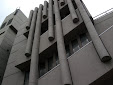
We, The World Congress, believe that the cumulative effect of the geographical concentration of these two events in the week beginning 11th May 2015 has probably shifted psychogeographical ley lines across the UK, or at the very least at significant points north of Birmingham. It is also quite likely that at what are known as ‘perambulatory hinges’, such as the one located at the University of Loughborough near the brutalist halls of residence (Towers) and also that situated on the roundabout near Burley’s Flyover in Leicester, have been totally thrown off orbit!

You can also see Dr Bridger's account of events, including much more information on the game itself, here: Not Another Psychogeography Blog:

"Lest we forget to mention, there was a special guest appearance by David Bollinger, Director of the West Yorkshire Association for Psychogeography at the Class Wargames event at the University of Huddersfield. His contribution was vital to enabling the Austrians to win the battle of Marengo, thus turning history ‘on its head’ and preventing the French from winning!"
 CEO of Huddersfield Psychogeographical Network