Places of the Heart: The Psychogeography of Everyday Life by Colin Ellard (2015)
This is a short review of/commentary on Colin Ellard’s new book.
Ellard is a cognitive neuroscientist at the University of Waterloo. Here's a quick summary of what he does (from his own website):
I work at the intersection of psychology and architectural and urban design, conducting experiments that measure how your brain and body respond to different kinds of settings. I also write accessible books and articles based on my scientific work, and travel the world trying to figure out how to build better places.
And this is the summary of the book from the blurb on the back cover:
In Places of the Heart, Colin Ellard explores how our homes, workplaces, cities, and nature – places we escape to and can’t escape from – have influenced us throughout history, and how our brains and bodies respond to different types of real and virtual space. As he describes the insight he and other scientists have gained from new technologies, he assesses the influence these technologies will have on our evolving environment and asks what kind of world we are, and should be, creating.
I came across
Places of the Heart on twitter by simply searching for the term #psychogeography, which I do on a regular basis, since it is my academic field. While I was waiting for it to arrive in the mail, I posted on my Facebook page a link to the book. While the general consensus was that it might be ‘too sciencey’ to be psychogeography, I am generous with the use of the term and also wanted to reserve judgement till I had read the book. Having now read it, I think it deserves a place within the contemporary canon of psychogeography, even though it does take a scientific approach, which some people may think goes against the subjective aspect of ‘classical’ psychogeography and might be considered reductive. The book has chapter headings such as: ‘Places of Lust’, ‘Boring Places’ and ‘Places of Affection’, so it is clear from this that we are still talking about how people ‘feel’ about place – and what is wrong with backing that up with some neuroscience! While I could write more about this side of the book, what I would like to do is provide an anecdote which actually helps situate the book within a specific field of study (and practice) which may be of interest to people who might only tangentially be connected to psychogeography: architects and architecture students.
In October I was invited to the
Canterbury School of Architecture to talk about
schizocartography (my own version of psychogeography) and at the end of the lecture I wanted to recommend some books to them that were at the intersection of psychogeography and architecture. I took with me
Walking Inside Out: Contemporary British Psychogeography (obviously, since this is my own edited volume and also came out this year, so is very current),
The Psychogeography of Urban Architecture by David Prescott-Steed (2013) (also very recent, and the title is a clue to how it might interest my audience) and Ellard’s new
Places of the Heart.
These three texts are very different from each other in content and style, yet they all use the term ‘psychogeography’ in the title.
Walking Inside Out, as the subtitle suggests, includes chapters that represent British psychogeography today. While architecture does appear in the content (it even has its own section in the index), it is more broadly related to urban space in general. A number of the index references to architecture cite the Situationists critique of architecture under the rubric of their unitary urbanism project, although there are other references. The
Psychogeography of Urban Architecture, while very psychogeographical in that it includes many of psychogeography’s common themes - subjective responses to urban space, walking in the city, personal accounts, cultural/philosophical critique, etc – it does not directly discuss architecture, but in a way it is always talking about it. You cannot really separate architecture out of a critique of urban space. However, in the use of the word as it pertains to architects, the title may be misleading to those not from a psychogeography background. Rather, the book is not about architecture per se, even though it is a super book in many other ways.
Out of the three books I took to Canterbury, the book I actually recommended to the architects (the lecturers) and the architects-in waiting (the students) was Ellard’s book. The biggest section in the index is ‘architecture’! Ellard talks about Gothic and Malian architecture, he talks about public housing and retail architecture and he even discusses “cognitive science’s collision with architecture”:
It seems a risky course to so scientize design that the creative vision of architects is force-fed into a reductive sausage grinder that can only produce quasi-Corbusian designs of the kind that we’ve already tried and found wanting. Nevertheless, allowing architects to have unfettered access to fecund imagination untroubled by psychological realities of what seems to work in a building also seems unwise. (page 219-220)
Also, interestingly, this was the book out of the three that the students were most interested in, although I appreciate it may have been because I was recommending it in this specific setting. So…despite the fact I should be promoting my own book, I think that this would be a good book for architects who might be interested in how the field of psychogeography intersects with their own work. Then, once they have read that, they can read
Walking Inside Out to find out what is going on at the cutting edge of British psychogeography!
Related Links:
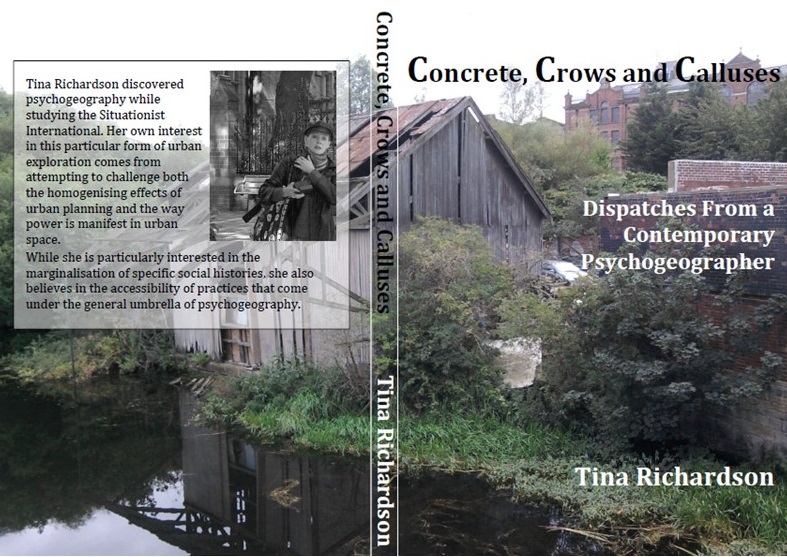
Concrete, Crows and Calluses – Book Review
On Walking – Book Review