Showing posts with label Roger Stevens Lecture Theatre. Show all posts

Saturday, 24 November 2012

Postwar University Campus Expansion: Part 2 - Campus as Urban Laboratory


(please click here for part 1 of this blog)

The 1960s campus development by Chamberlin, Powell and Bon (CPB) was the fourth of four main architectural moments for the University of Leeds. These periods had different architects (both in-house and hired ones) attached to them, were situated in different periods and had styles that were distinct from each other, both in design and often in the material used. The university inherited the Yorkshire College redbrick buildings from prior to its 1904 university charter, although still continued to use the terracotta bricks on occasion, as can be seen in the Beaux-Arts style Brotherton Library, completed in 1936. The campus site was redeveloped in the 1920s with Art Deco influenced buildings, often containing neo-classical elements like the Parkinson Building, and mostly made in Portland Stone, although not exclusively. While some of the previously planned buildings were not actually finished until after the war, it is clear from their style they emanate from the 1920s and 1930s, rather than their period of completion, sometimes the 1950s, as is the case with the Parkinson Building. The Parkinson Building is the iconic building associated with the University of Leeds (see image below). It appears as if it is the entrance to the university itself but was actually designed to be the entrance to the Brotherton Library and it is thought that the modern look of it would hide the, then considered, old-fashioned redbrick library behind it.


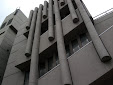
The 1960s and 1970s development, overseen by the in-house architect Geoffrey Wilson in conjunction with CPB, introduces what is considered by many to be Brutalist architecture, a term coined by the the education building architects Alison and Peter Smithson, although its ideas are oriented in Le Corbusier. At the University of Leeds the Brutalist architecture is manifest in the typical materials of concrete, glass and steel, epitomised by the Roger Stevens Lecture Theatre which now has Grade II listed status (see first image). On the campus itself, these differing architectural periods are buffered up to each other, creating both an interesting and aesthetically challenging dynamic which makes the space have a heterogeneous feel in its spatial representation. The challenge for the university and CPB, then, was manifold and included such problems as creating a holistic and cohesive campus, offering a look and feel that would signify the vision of a new university, and to do this within the scope and limitations set by both the university and the city itself. This holistic approach to the space and architecture is one of the qualities that Chamberlin, Powell and Bon were known for, and ultimately became one of the functional aspects of the new university campus at Leeds: "A university should have a sense of wholeness which is not fostered by segregated planning." (Chamberlin 1969: 3)


The second Development Plan (1963 - the first was published in 1960) concentrated on the area around what came to be known as Chancellor's Court and its surrounding precinct (see above image). This included departments for maths, science and also administration buildings along with what became the Roger Stevens Lecture Theatre, although the final design of the theatre differs greatly from the one that appeared in the plan). Such was the significance of the hiring of CPB for this project, that the two Development Plans became significant documents in their own right on an international level. And, William Whyte in his article 'The Modernist Moment at the University of Leeds, 1957-1977' (2008), even includes mention of these plans in his abstract, stating "The Development Plan also highlights the way in which architects of the British modern movement used universities as laboratories in which to experiment with ideas about community and proper urban design." (2008: 169) Having previously completed the famous Golden Lane Estate, along with the nearby Barbican complex in London (which included a school) and also two other schools, CPB themselves were seen as the architects du jour, and these development plans became a kind of 'blueprint' for the modern university.

Related Links:
Postwar University Campus Expansion: Part 1 - Channeling Venetian Plazas
Bodington Halls
The University of Leeds: A Very Short History

Bibliography:
Chamberlin, Peter. 'The Evolution and Realization of the University Development Plan', The University of Leeds Review, 12, 1 (May 1969), 3-17.
Whyte, William. 'The Modernist Moment at the University of Leeds, 1957-1977', The Historical Journal, 51, 1 (2008), 169-193.

Saturday, 13 October 2012

Chamberlin, Powell and Bon: Does the old campus make sense in the present? - Part 2


This is a part 2 of my blog on Owen Hatherley's comments on the Brutalist period at the University of Leeds from A Guide to the New Ruins of Great Britain. Please click here for part 1 and part 3:

That the University doesn't know what to do with the campus is obvious enough. In early photos, you can see the central space occupied by the sculpted nature of a planned garden, akin to the designs of the Brazilian landscape artist Roberto Burle Marx. In recent years the University filled the whole space with such a quantity of street furniture, foliage and inelegant public art that you can almost ignore the building. meanwhile the concrete - sculptural, shuttered stuff similar to that used in Chamberlin, Powell and Bon's hugely successful Barbican complex in London - was painted in estate-agent magnolia, and the halls of residence are being demolished, it being easier to house students in the barracks provided by the likes of Unite. The old campus is a place that cannot make sense in the present, yet this might be what is most valuable about it.


There is so much to comment on in this paragraph, but here I shall only be discussing Hatherley's remark on the campus not knowing it's purpose and will comment on the halls of residences being demolished in part 3.

Firstly, "That the University doesn't know what to do with the campus is obvious enough". It's not apparent what Hatherley actually means by this. Does he mean in regards to it's overall design? It's aesthetic style? Or just the general practicalities of placing much needed new buildings into the gradually diminishing space? When taken in the context of the last sentence - The old campus is a place that cannot make sense in the present - perhaps we can assume this is an issue of identity.

This is an interesting point because I think if he were taking about a city in postmodernity, he wouldn’t make the same remarks. A city, say, like London that contains many differing periods of architecture, buffered up against each other, and shoe-horned into small spaces - a typical postmodern city. However, if we compare The University of Leeds to some of the American campuses, say UCLA, I think it makes more sense. UCLA has a very distinct aesthetic which means it is presented to the occupant of that space, the spectator if you will, as a homogeneous place.


Much of the UCLA campus is built with this pale apricot brick. It makes buildings from different periods look more similar and gives the illusion they were not built years apart. While there are some different looking buildings on the UCLA campus, in different architectural styles, the main section looks like the building above. I would describe UCLA as a pristine-looking campus. However, it doesn't have the richness and diversity that the University of Leeds campus has on an aesthetic level: while the UCLA campus is much more 'lovely' it is not nearly as 'interesting' as Leeds.

Other Related Blogs:
At UCLA You See LA

Saturday, 6 October 2012

Chamberlin, Powell and Bon: Space Age or Quasi-Totalitarianism? - Part 1


Here are Owen Hatherley's comments on the Brutalist period at the University of Leeds from A Guide to the New Ruins of Great Britain, plus some of my own commentary and images:

"Leeds University in particular can boast one of the most impressive attempts to design an inner-city campus as a total, coherent environment, albeit without the need for CCTV and gating - the complex of university buildings designed by Chamberlin, Powell and Bon between 1958 and 1968."

"Local rumour has it that this complex served as a set for the seventies science fiction series Blake's 7. This should come as no surprise. There is a divide in the perception of these buildings between the future they seem to suggest - a space-age society with egalitarian buildings make no reference to anything so prosaic as local materials, human scale or history, which some of us may find liberating, other unnerving - and the past they are most often seen to represent. That is, the other 1960s, not the now very familiar decade reminisced over by ageing soixante-huitards but the decade of a new landscape of towers and slabs, walkways and motorways, which is only very slowly starting to come back into favour after decades in which it was abhorred by many as an example of top-down quasi-totalitarianism, often better known for its transformation into film-set dystopias at the hand of Kubrick, Truffaut and Antonioni."


Chamberlin, Powell and Bon produced two bound plans for the university in the early 1960s (see above image). I don't think it would be a stretch to describe them now as objet d'art in their own right. These publications were distributed to university staff at the time. They aren't that easy to get hold of today. I have seen them for sale for as much as £100 online.

Chamberlin, Powell and Bon's vision was futuristic, as suggested by Hatherley, but it was also a contemporary response to the need for an expanded campus that could accommodate all the new postwar students. While it included the idea of students communing in Italian inspired piazzas, it also took a very rational and economic approach to the use of space. This even appeared in the form of 'joker' floors on the top of teaching buildings, which could easily be converted to teaching, administration or residential floors. Until recently some of these floors were still residential halls, as was the case in the Social Sciences building.

Whether you like, dislike or are indifferent to Brutalist architecture, much of it is now being listed, as are a number of these buildings at the University of Leeds, including the Roger Stevens Lecture Theatre shown in my first photo. So, its legacy is still really a work-in-progess. Elain Harwood, in her recent book on Chamberlin, Powell and Bon, when commenting on these university buildings says: "They have proved to be as adaptable as Chamberlin had promised, with the walls moved ad infinitum and service ducts coping with increased loadings. [...] The teaching buildings were listed in 2009, to ensure the conservation of their special qualities."

Apparently it is an urban myth that Blake's 7 was filmed there...


Other blogs in this series:
Chamberlin, Powell and Bon: Does the old campus make sense in the present? - Part 2
Chamberlin, Powell and Bon: The Return of the Repressed - Part 3

Wednesday, 8 June 2011

Happy Accidents #2 - University of Leeds


These Lomography images were taken in May on the University of Leeds campus. These are my two favourite images of the day taken with my Diana F+. Although it isn't clear what's going on in the above one, it is a superimposed image of the Roger Stevens Lecture Theatre and a campus signpost and the buildings behind it. I think it produces a slightly uncanny effect whereby you can't work out what buildings belong to what image. Also, the signpost is in such a place where it looks like the beige building on the right is abutted to the grey concrete building in the background.


This image is also superimposed. It is of the Clothworkers' Centenary Concert Hall (what used to be the Presbyterian Church) and a lovely tree nearby that was in bloom with yellow blossom. The effect is of golden light emanating from the church door, which is interesting from a religious perspective, even though it wasn't my intention.

Related Links:
Lomography
Presbyterian Church on Leodis
Roger Stevens Lecture Theatre - Listed Building

Wednesday, 1 June 2011

The Sound of the Sixties - Brutalist Architecture


Film: The Sound of the Sixties

During the major planning drive by the University of Leeds that took place after World War II, architects were employed to draw up plans to expand and develop the campus. Many architectural plans were made, alongside two large bound proposals prepared by the architects Chamberlin, Powell and Bon, who are most famous for their concrete brutalist architecture in places like the Barbican - the grade II listed complex of housing, education, office and exhibition space located in the City of London, completed in 1976. Much of the text of the reports that Chamberlin, Powell and Bon submitted to the university is oriented towards a section of the campus referred to as “the precinct”. The precinct area includes plans for a number of very large buildings and vast car parking zones. Part of the conclusion of the 1963 report by the architects says the following:

No effort has been spared in Leeds on the part of the City Authorities, the Hospital Board and the Council of the University to make the planned expansion possible despite the extreme difficulties inherent in the comprehensive re-planning and redevelopment of the old City sites which have hitherto rested in many ownerships and were laid out between a network of streets obsolete for any present purposes.

The innovative architectural designs of Chamberlin, Powell and Bon were not only aspirational for the University of Leeds, but also British universities in general. The university led the way in rethinking the nature of university architecture, and in employing a younger generation of designers to build it. While the University of Leeds was not the first to embark on a rebuilding effort during this period, they were the first to deal with the campus in a holistic way.


This 3 minute film is an acoustic psychogeographical response to the area called the precinct and features two of the most impressive of the buildings designed by the architects: the Worsley Building and the Roger Stevens Lecture Theatre (now a Grade II listed building).

The film alludes to a moment-in-time architecturally, with the popular cultural reference of the title - The Sound of the Sixties, a radio and TV series playing pop music form that era - and the 1964 track by the R&B British pop band Manfred Mann. The song title 5-4-3-2-1 provides a countdown to the walk, which was actually 8 individual edited films, appearing in the sequence they were recorded.

So as to avoid being distracted by the campus scenery only the feet were shot, they being the instrument used to tap out the sound on the surface of the topography of the precinct. I considered just supplying the sound without the visuals of the walking feet, but I decided that the trace left by the feet becomes a form of cartography which has a number of functions that to me, as a psychogeographer, are important, and which also support the tenets of schizocartography (my own particular form of psychogeography):

1. they make a claim to that space, even thought it is a momentary one
2. they attach an identity, however nebulous, to the walker
3. by revealing the feet and the surface of the terrain, focus is directed towards part of the production process behind the sound-making, the mise en scene of the film


Chamberlin, Powell and Bon were considered not to be very vocal architects, and there is little information on them and even less by them, other than their architectural work. So, in a way I consider this film to be in part a homage and in part a challenge to the space of the precinct in the sense that it might be perceived as a spectacle. I shall conclude by quoting Penelope Curtis from the Henry Moore Institute's publication The New Monumentality.

How should we interpret the work of such silent architects? In the words they chose to use in the meticulously prepared reports for the Court of the City of London or for the Court of the University of Leeds? In the words of others? There were reviews enough in the 50s and 60s on their newly published projects and realised schemes, even if there has been almost nothing published since. Or should we interpret their work through the language of the forms themselves?

I hope, however unconventional it might be, that perhaps I have given sound, if not voice, to the work of Chamberlin Powell and Bon at the University of Leeds, while simultaneously staying faithful to my own project of challenging anti-production through the process of schizocartography.


Relevant links:
Chamberlin, Powell and Bon on e-architect
The Barbican
University of Leeds listed buildings