Sunday, 24 February 2013

The Parkinson Temple: How does ideology influence our aesthetic experience? (part 1)


The Parkinson Building at Leeds University is considered to be the symbol of the university: it is also part of the graphical representation of the university logo, it therefore denominates the ‘brand’. What I propose to do is demonstrate how Martin Heidegger’s “temple-work” (2000, p.91) could be theoretically applied to the Parkinson Building. I believe that this approach is more productive in demonstrating the ideology behind the architecture than using the model that Heidegger applies to art.

To the Greeks their temples were not places of worship but rather the material symbol of their gods. The temples themselves were built on holy sites that represented the force of nature symbolised in that particular god or group of gods (Scully 1979, p.7):
With the coming of the temple, housing its image within it, itself developed as a sculptural embodiment of the god’s presence and character, the meaning becomes double, both of the deity as in nature and the god as imagined by men. (ibid.).
Temples were built to please the deities and became the earthly representation of the gods in manifest form, thus becoming a focal point for the citizens and highlighting its centrality to their lives.

In his essay ‘The Origin of the Work of Art’ Heidegger makes it clear that the temple reveals little in terms of its content. It is what it represents that is important because “god is present in the temple.”: it is this understanding and the power invested in the object by the people that designates its authority. (2000, p.89) According to Heidegger the temple’s centre of power forms the nexus for the connections and relationships which guide the lives of the people and frame their future (ibid.). Friedrich Nietzsche also discusses how the creative drive behind a work of art, in the sense of its “completion and consummation of existence, and as a guarantee of further existence”, is the very same drive as the will that gave rise to the notion behind the realm of the gods (1956, p.30). He explains how this reciprocal process imbues the gods with a power that offers itself back to the people, it thus becomes a “transfiguring mirror” (ibid.). It is this self-reflexivity I would like to concentrate on here, and how the ideology behind it informs the aesthetics for the individual.

The temple serves many functions: it constitutes the law, society and culture; it is the central point of socio-cultural connections; and it is also the originator of truth and knowledge, because it “makes visible the invisible” (Heidegger 2000, p.89). The temple could be compared to the theological ‘ground of being’ in that it is the whence from which everything emanates and that in which everything returns. As Heidegger explains, the early morning light lands on the temple marking the beginning of the day to the people; the form and order of their world is thus defined and the citizens go about their day within this pre-given framework (ibid.). Later the sunset signals the closing down of the world, and the people return home having made meaning and sense out of their day: “the naming power of the word.” (Heidegger 2000, p.91). Tomorrow brings a new dawn and the process begins again. Michel Foucault explains how in this period of history “The universe was folded in upon itself: the earth echoing the sky, faces seeing themselves reflected in the stars” (2005, p.19). In ancient history the world was smaller, social relationships were well-defined and prescribed boundaries were clearly delimited.


At this point I would like to jump ahead about three thousand years and introduce the Parkinson Building at the University of Leeds. The Parkinson Building was funded by a £200,000 donation from the local industrialist Frank Parkinson who was educated at the university (Gosden and Taylor 1975, p.166). The Parkinson Building superseded the Brotherton Library as the new frontage to the university. Funding was short when it came to completing the entrance to the Brotherton Library and when Parkinson’s welcome bequest arrived a much grander façade was planned (ibid.). Thus, the exterior of the Brotherton Library became subsumed in the Parkinson Building and now exists in a kind of enclave - today it can only be seen through the windows at the rear of Parkinson Court and via other surrounding buildings. The students of postmodernity can peer back though history from the position of the current symbol of the ‘temple of knowledge’ and view its past incarnation, the Brotherton Library: yesterday’s version of truth. This confirms Győrgy Lukacs point that a work of art as well as showing a new order of things, replacing an older one, will at the same time have an ideological effect (cited in Rieser 1957, p.239).

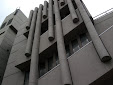
The Parkinson Building was designed in the 1930s. The architecture highlights many Art Deco qualities, for instance horizontal lines and Neoclassical elements, but is not as highly decorated as some buildings from the same period. It could be considered to be one of the “stone-sheathed giants” (Bayer 1992, p.7) that were erected in urban areas at this time. The University of Leeds sits on a hill and upon approaching it from the south the imposing Parkinson Building fills your vista. The symmetrical building has a centralised entrance with steps leading to a number of doors. A substantial phallus-like clock tower, reminiscent of many office or industrial buildings of that period, crowns the building. The Parkinson Building was not completed till 1951 due to a suspension in building during the war period.


In an attempt to concentrate on the ideological aspects of the aesthetic response, I do not plan to dwell further on the architectural elements of the Parkinson Building and have offered them here to contextualise the building itself. To further my hypothesis I would like to include a pertinent quote by Parkinson himself on some ideological expectations he had of the building’s design:
I have in mind that in addition to the provision of Chambers more befitting the dignity of the Council and the Senate they should include an Entrance and Entrance Hall which would leave an indelible impression on the mind of the student which he would remember in after years with affection. (Gosden and Taylor 1975, p.166)
It is clear from this request, and from the planned grand entrance for the Brotherton Library, that the Parkinson Building is designed to be impressive and make a statement about the university. This demonstrates an ideology inherent in the architecture itself; an ideology that becomes part of the very fabric of the building. As G. W. F. Hegel states, architecture can build meaning into its very form and material (2000, p.47). Heidegger explains that in this process the material is “set forth” and in its “consecrating praising erection” the temple is then “setting up a world” (2000, p.91), as we can see reflected in Parkinson’s comments above. When it comes to cultural objects we could say that the glue of matter and creation is form, and that very form is ideology itself.

Part 2 of blog

Bibliography:

Althusser, Louis. 1971a. ‘A Letter on Art in Reply to Andre Daspre’, Lenin and Philosophy and Other Essays, trans. by Ben Brewster (London, New York: Monthly Review Press) pp. 221-228.

Althusser, Louis. 1971b. ‘Cremonini, Painter of the Abstract’, Lenin and Philosophy and Other Essays, trans. by Ben Brewster (London, New York: Monthly Review Press) pp. 29-242.

Bayer, Patricia. 1992. Art Deco Architecture: Design, Decoration and Detail from the Twenties and Thirties (London: Thames and Hudson).

Benjamin, Walter. 2004. ‘The Work of Art in the Age of Mechanical Reproduction’, Art in Theory – 1900-2000, ed. by Charles Harrison & Paul Wood (Oxford: Blackwell Publishing) pp. 520-527.

Derrida, Jacques. 2004. Writing and Difference, trans. by Alan Bass (London: Routledge).

Foucault, Michel. 2005. The Order of Things (Abingdon, New York: Routledge).

Gosden, P. H. J. H. and Taylor, A. J. 1975. Studies in the History of a University 1874-1974 (Leeds: Arnold and Son).

Hegel, G. W. F. 2000. Extracts from ‘Aesthetics: Lectures on Fine Art’, The Continental Aesthetics Reader, ed. by Clive Cazeaux (Abingdon: Routledge) pp. 35-52.

Heidegger, Martin. 2000. ‘The Origin of the Work of Art’, The Continental Aesthetics Reader, ed. by Clive Cazeaux (Abingdon: Routledge) pp. 80-101.

Nietzsche, Firiedrich. 1956. The Birth of Tragedy and The Genealogy of Morals, trans. by Francis Golffing (New York: Doubleday Anchor).

Rieser, Max, ‘The Aesthetic Theory of Social Realism’, The Journal of Aesthetics and Art Criticism, 16, 2 (1957) pp. 237-248.

Scully, Vincent Joseph. 1979. The Earth, the Temple and the Gods: Greek Sacred Architecture (New Haven, London: Yale University Press).

Wednesday, 13 February 2013

Concrete, Crows and Calluses


Tina Richardson discovered psychogeography while studying the Situationist International. Her own interest in this particular form of urban exploration comes from attempting to challenge both the homogenising effects of urban planning and the way power is manifest in urban space. While Tina is particularly interested in the marginalisation of specific social histories, she also believes in the accessibility of practices that come under the general umbrella of psychogeography.

Tina's book is available here, where you can also read reviews, see ratings and also see the first few pages of the book: Concrete, Crows and Calluses

The writer Ian Marchant has kindly written a blog about the book: Teachers Getting Lost
And so has Mythogeography

Below you can read the preface and contents page . . .

Thursday, 7 February 2013

The Morphology of Trinity


Last Sunday (3rd February 2013) I went to investigate the topography of Leeds Trinity University College campus. It is about 30mins walk from my own house in Horsforth. As you can see from the map below, a large proportion of the campus is dedicated to playing fields and sports facilities. The map also shows a nature trail which I hadn't noticed when I was visiting (note to self: revisit needed).


Below is the main building on campus. This is where the reception is located. On the map it looks huge (it is the large square building with the courtyard in the middle - the size of the Pentagon!), but on the ground it seems much smaller. I went in to ask at the security desk if there was a cafe open at the weekends, but there isn't. However, on paying a few pence, the chaplaincy will let you make your own coffee in the chapel kitchen. Very nice!!


Leeds Trinity University has undergraduate courses such as Accounting, Business, English, Journalism and Media. It recently achieved university status (2012) and can now bestow its own degrees. They have also just rebranded, to account for this (big banners at Horsforth train station). The news du jour on their website states that applications are up by a whopping 61%! My guess would be that this has a lot to do with the recent hike in tuition fees, making it far cheaper to gain higher education locally, while still living at home. That and the fact that student fees there are £8,000 (I am loathe to say 'only'). While this is still a huge amount, it is less than the fee at most other universitys.

The campus is an interesting place, a modern suburban college-university on the edge of a small town, Horsforth (Leeds, UK). However, I  hardly ever seem to see the students around in the local High Street when I am up that way, even though it is only a short walk away from the campus. There is also a neat little Trinity bus (free, I think) that does a regular circular route around the area. I feel that there are a good number of students at the university, not just going by the large selection of courses, but also because of the many halls of residence based on the site (see below). So where do they hang out???


Saturday, 26 January 2013

Schizoanalytic Cartographies Part 3: Guattari on Postmodernity


This is part three of my series of blogs on Félix Guattari's Schizoanalytic Cartographies. Please click here for part one and two:
1 - Psychoanalysis and Religion
2 - Guattari on Enunciation

This extract includes some of Guattari's comments on postmodernity. Here he critiques the demise of social relations in a somewhat polemic fashion, but despite that this extract does highlight some of the themes associated with postmodernism - style over content, the decline of grand narratives, etc.:
A certain conception of progress and of modernity has gone bankrupt, compromising in its collapse collective confidence in the very idea of emancipatory social practice. In parallel, a sort of glaciation has taken over social relations: hierarchies and segregations have rigidified, poverty and unemployment tend to be accepted today as inevitable evils, the unions cling onto the last institutional branches conceded to them and are imprisoned in corporatists practices leading them to adopt conservative attitudes that are sometimes close to the of the reactionary milieus. The communist left is irremediably stuck in sclerosis and dogmatism, whilst socialist parties concerned to present themselves as reliable technocratic partners have given up any progressive questioning of existing structures. It is not surprising, after all that, if the ideologies that once claimed to serve as a guide to rebuilding society on a less unjust, less unequal basis have lost their credibility. (page 36)
Does it follow that we are henceforth condemned to stand around like idiots in the face of growth of the new order of cruelty and cynicism that is on the point of submerging the planet, with the firm intention, it seems, of staying? It is this regrettable conclusion that numerous intellectual and artistic milieus effectively seem to have reached, in particular those who invoke the fashion of postmodernism. (page 36)


Whether they are painters, architects or philosophers, the heroes of postmodernity share an assessment that the crises the artistic and social practices are experiencing today can no longer lead into anything other than irrevocable refusal of any collective projectuality of any scale. Let's tend our garden then and preferably in conformity with the habits and customs of our contemporaries. No waves. Just vogues, modulated on the markets of art and opinion by means of publicity campaigns and opinion polls. As for ordinary sociality, a new principle of 'sufficient communication' will have to provide for the maintenance of its equilibria and ephemeral consistency. If one thinks about it, how much distance has been travelled since the epoch in which one could read on the banners of French sociology: 'social facts are not things'! For the postmoderns, they are now nothing more than erratic clouds of floating discourse in a signifying ether! (page 39)

If you are interested in other philosophical discussions on postmodernity and culture, I would also recommend the following texts:

Jean-Françoise Lyotard The Postmodern Condition: A Report on Knowledge
Fredric Jameson Postmodernism: The Cultural Logic of Late Capitalism

Sunday, 13 January 2013

Schizoanalytic Cartographies Part 2: Guattari on Enunciation


This is the second of my series of blogs on Guattari's Schizoanalytic Cartographies. Please click here for part one: Psychoanalysis and Religion Thanks for all the hits on my first blog in the series, I hope this one is as popular.

I'd just like to define a couple of terms before I include an interesting section on enunciation by Guattari, where he provides a neat analogy with the conductor of an orchestra.

Assemblage
For Guattari (and Deleuze) individuals are multiplicities which come together briefly through movement and rest. The parts that make up the individual are not constant but are continually formed, disassembled and re-formed in different combinations. These parts do not belong to the individual, they only temporarily constitute her and emanate from the environment of that particular situation. This is an assemblage. Assemblages do not just refer to individuals but to any collection of this kind, and operate on a “plane of consistency”, which is not hierarchic in nature. At the point people are considered to be communicating, Guattari describe this as an “assemblage of enunciation”.

Deterritorialization
These types of topographical terms are what is great about Guattari's work in applying it to urban space and psychogeography, in the way that it enables me to do with schizocartography. Anyway...I am going to cheat with this definition as I don't have one of my own to hand. Here's Guattari's from The Anti-Oedipus Papers: "Territory describes a lived space, or a perceived system in which a subject 'feels at home'. Territory is synonymous with appropriation, subjectification closed in on itself. A territory can also be deterritorialized, i.e. open up, to be engaged in lines of flight, and even become deleterious and self-destructive. Reterritorialization consists of an attempt to recompose a territory engaged in a process of deterritorialization."


Enunciation is like the conductor who sometimes accepts his loss of control of the members of the orchestra: at certain moments, it is the pleasure of articulation or rhythm, if not an inflated style, which sets out to play a solo and to impose it on others. Let's emphasize that if an Assemblage of enunciation can include multiple social voices, it equally takes on pre-personal voices, capable of brining about aesthetic ecstasis, a mystic effusion or an ethological panic - an agoraphobic syndrome, for example - as much as an ethical imperative. One can see that all forms of concerted emancipation are conceivable. A good conductor will not attempt despotically to overcode all the parts on the score, but will be looking for the collective crossing of the threshold at which the aesthetic object designated by the name at the top of the score is attained. 'That's it! You've got it!' Tempo, accents, phrasing, the balancing of parts, harmonies, rhythms and timbres: everything conspires in the reinvention of the work and its propulsion towards new orbits of deterritorialized sensibility...(page 210)
Part three of the blog is here: Guattari on Postmodernity

Saturday, 29 December 2012

Schizoanalytic Cartographies Part 1: Guattari on Psychoanalysis and Religion


Félix Guattari's Schizoanalytic Cartographies has finally been translated into English. I've been waiting for it for a year since I heard it was going to be published. This series of blogs will include some short discussions - or 'tasters' if you will - of Guattari's that are included in the book and you might find interesting. I've deliberately sought out the more jargon-free passages, so as to make them accessible to those of you who may be interested in the title of the blog, but not familiar with Guattari's own work:


Psychoanalysis is not a science; it is not an art, it is not for all that a religion - although it does mobilize powerful phenomena of belief, Freud is venerated like a Father of the Church, his first patients are celebrated like holy martyrs, his writings treated like the Gospel and the congregations that invoke him practise the excommunication of schismatics just like in the good old days of the Inquisition...I have already mentioned the difference in position of religious and psychoanalytic subjectivity with regard to scientific rationality, the first ostensibly separating itself from it, the second endeavouring to absorb it in various ways. Two other different equally deserve to be noted: 1) psychoanalysis requires a more active participation of its users in its rituals; 2) its myths are more deterritorialized that those of religion.
Psychoanalysis and the monotheistic religions have in common that they seek to grip subjectivity in ethical axes in conformity with the requirements of what I will call capitalistic logics, that is to say, systems of judgement proceeding by generalized equivalence, the conjuring and repression of animist intensities, the conversion of singular trajectories, the system of reiteration and circulation of formal entities on deterritorialized 'markets' (those of the economy, of morality, of art...) . Whilst, to achieve their ends, religions act by direct suggestion, by the imprint of standardized representations and statements, at least to begin with psychoanalysis gives free reign to a certain individual expression, the better subsequently to take it over and to submit of its own accord to other, perhaps even more tyrannical, kinds of stereotypes. Whilst religion, dare I say it, straitjackets subjectivity in the open air, psychoanalysis gets rid of some of the ballast of statements in order to concentrate its efforts on remodelling enunciation. (Guattari, page 43)

Part two of this series of blogs is here: Guattari on Enunciation
Part three of this series of blogs is here: Guattari on Postmodernity
If you would like to see a 'methodology' for using schizoanalysis in conjunction with psychogeography, please visit my website: Schizocartography

Saturday, 8 December 2012

Postwar University Campus Expansion: Part 3 - The New Monumentality


Please click here for part 1 and part 2

In the summer of 2009 the Henry Moore Institute in Leeds organised an event called The New Monumentality. It comprised of a half day seminar supporting the current exhibition which showed artists responses to campus spaces exploring the architectural modernity of the 1950s and 60s of which they inherited. Two out of the three artists included work that had been influenced by the University of Leeds campus. The seminar was called Building the Future and examined modernist campus architecture in the context of cultural theory and architectural aesthetics. A campus walk followed the seminar at the end of the day.


During the seminar human the field of capital theory was discussed in regards to education. It has been used as an "economic device" since the 1960s as a way of measuring performance. (Fitzsimmons 1999: 1) It became popular at this time due to education being included as a key part of the global economy, and sees "human activity" as " the exchange of commodities and the notion of capital employed is purely a quantitative one." ( Fitzsimmons 1999: 3) This means that individuals sell their education (themselves) on the market, and their degree becomes part of the exchange value for their employment. What this capitalistic approach ignores, amongst other factors, is the value of knowledge as it is for the individual, because it only concentrates on the performative aspect of education, the input/output regimen. What we see as the corporatised university of today, has its origins in the 1960s where something that could be considered a Fordist or Taylorist approach began to be applied to education, as can be seen in the University of Leeds development plan in terms of moving bodies around the campus, and the economic and efficient use of space (as discussed on previous blogs).


It is the supporting structures in the form of the educational apparatus, the discourse of the university and the abstract and concrete space of higher education that helps form the subjectivity and identities of university students (today, even more than in the 1960s, at a time where course fees are now around £9,000 per year, students see their own degree in terms of an economic investment). In their article entitled 'Academic Architecture and the Constitution of the New Model Worker' Philp Hancock and André Spicer consider how campus spaces orient the subjectivity of students "towards the production of economically viable modes of identity conducive to the demands of a post-industrial economy." (2011: 91) While their article is a recent one, looking at a contemporary situation at Glasgow Caledonian University - their new library called the Saltire Centre - it nevertheless provides a spatial and ideological analysis which would be relevant in applying to any period of campus architecture.

(images courtesy of the University of Leeds)

Related Links:
The New Monumentality
The University of Leeds: A Very Short History

Bibliography:
Fitzsimmons, Patrick. Encyclopedia of Philosophy of Education, 'Human Capital Theory and Education', (1999), [accessed 25 September 2012]
Hanccock, Philip and André Spicer. 'Academic Architecture and the Constitution of the New Model Worker', Culture and Organization, 17, 2 (2011), 91-105.